
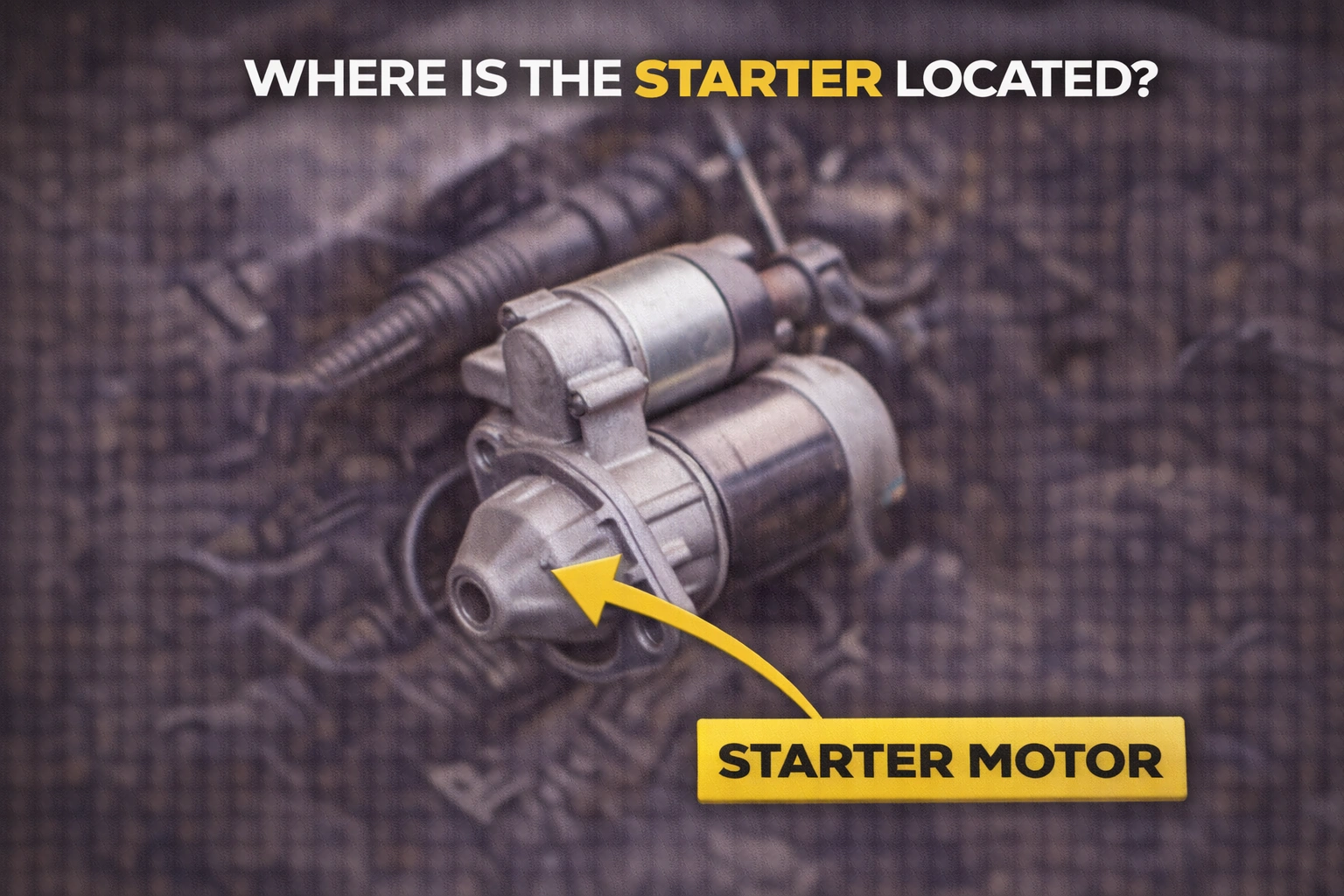
Every time you turn the key or press the start button, a small but powerful motor brings your engine to life. That component is the starter. Without it, the engine cannot crank, and the vehicle will not run. Despite its importance, many drivers have never seen a starter or know where it sits inside the vehicle. It is usually hidden deep within the engine bay, mounted in a place designed for both strength and function.
The starter must connect directly to the engine’s flywheel or flexplate to spin it during ignition. Because of this connection, its location follows a specific pattern across most vehicles. However, the exact position can vary depending on engine layout, drivetrain configuration, and vehicle design. Knowing where the starter is located helps with troubleshooting, inspection, and repair planning. It also makes conversations with mechanics clearer and more informed.
Table of Contents
Basic Function And Why Location Matters
How The Starter Works With The Engine
The starter motor’s primary job is to rotate the engine’s crankshaft during startup. When the ignition is activated, electrical current flows from the battery to the starter solenoid. The solenoid engages a small gear called the pinion, which meshes with the engine’s flywheel or flexplate.
As the starter motor spins, it turns the flywheel, allowing the engine to begin combustion. Once the engine fires and runs on its own, the pinion retracts automatically. This process happens in seconds, but it requires precise alignment.
Because the starter must physically connect to the flywheel, it is always mounted near the transmission bell housing. The flywheel sits between the engine and transmission, so the starter is positioned in that area for direct engagement.
Understanding this relationship helps narrow down the starter’s location quickly, even without a diagram.
Why The Starter Is Positioned Near The Transmission
The flywheel or flexplate attaches to the rear of the engine crankshaft. Since the starter gear must engage those teeth directly, it cannot be placed randomly in the engine bay.
Most vehicles position the starter at the lower rear portion of the engine block. It is typically secured with two or three bolts and connected with thick battery cables.
In front-wheel drive vehicles, space constraints may place the starter slightly higher or tucked closer to the intake side. In rear-wheel drive trucks, it is usually visible from underneath the vehicle near the transmission.
This placement ensures reliable gear engagement and protection from excessive engine heat.
Starter Location In Different Vehicle Types
Front Wheel Drive Vehicles
In front-wheel drive vehicles, the engine is mounted sideways. This transverse layout means the transmission sits beside the engine rather than behind it.
Because of this design, the starter is usually mounted near the lower section of the engine where it meets the transmission housing. In vehicles like the Honda Civic or Toyota Corolla, the starter often sits on the backside of the engine block facing the firewall.
Accessing the starter in these cars may require removing intake components or reaching from underneath. Tight engine compartments can make visibility limited without lifting the vehicle.
Despite these differences, the key indicator remains the same: look where the engine and transmission connect.
Rear Wheel Drive Vehicles
Rear-wheel drive vehicles typically use a longitudinal engine layout, meaning the engine faces front to back. In this configuration, the transmission sits directly behind the engine.
The starter is commonly mounted on the lower side of the engine near the bell housing. In trucks such as the Ford F-150, the starter is often easier to access from beneath the vehicle.
This layout provides more space around the engine, making starter replacement slightly more straightforward compared to compact front-wheel drive cars.
The large battery cable attached to the starter is another identifying feature when locating it visually.
How To Identify The Starter Visually
Recognizing The Shape And Wiring
A starter motor is cylindrical and larger than most sensors in the engine bay. It typically has a small attached solenoid mounted on top or to the side. Thick battery cables connect to it, unlike thin sensor wires.
The positive battery cable leads directly to the starter. Tracing that cable from the battery is one of the simplest ways to locate the component.
The starter’s housing is made of metal and often appears slightly larger than a soda can. Its position near the bottom of the engine distinguishes it from alternators, which are mounted higher and connected to drive belts.
Using a flashlight and inspecting the area where the engine meets the transmission often reveals the starter’s position.
Using A Service Manual For Confirmation
While visual inspection works in many cases, referring to a service manual provides exact placement details. Engine designs vary, and some vehicles may include protective covers or shields.
Manuals often provide diagrams showing mounting bolt locations and electrical connections. This helps avoid confusion with other components such as the alternator or power steering pump.
For vehicles with limited access, raising the car safely using jack stands improves visibility. Always follow safety precautions when working underneath.
Having accurate information before removing components prevents unnecessary disassembly.
Common Signs Of Starter Problems
A faulty starter often produces a clicking sound when turning the key. This may indicate a failing solenoid or insufficient electrical supply.
Slow cranking or no cranking at all can also point to starter wear. However, battery condition should always be checked first, as weak batteries mimic starter failure.
Intermittent starting issues sometimes signal worn internal contacts within the starter motor.
Testing voltage at the starter terminals confirms whether electrical power reaches the unit during ignition.
Replacing a starter usually requires disconnecting the battery first to prevent electrical hazards.
Final Overview
The starter is typically mounted where the engine connects to the transmission, positioned to engage the flywheel directly. Its location varies slightly depending on engine layout and drivetrain type, but it consistently sits near the lower rear portion of the engine block.
Front-wheel drive cars often hide the starter near the firewall side of the engine, while rear-wheel drive trucks position it along the lower bell housing area. Recognizing its cylindrical shape and thick battery wiring simplifies identification.
Knowing where the starter is located helps with troubleshooting starting problems and prepares vehicle owners for repair discussions. Accurate location awareness reduces guesswork and ensures safer inspection when maintenance becomes necessary.

- How Families in UAE Manage Changing Vehicle Needs - March 4, 2026
- How Many Axles On A Car And What They Do - March 2, 2026
- Metal Shavings In Oil Causes And What It Means - March 2, 2026