Construction sites are defined by movement, noise, and machines built to handle work that human strength alone could never manage. From clearing land to lifting steel, shaping roads, and finishing surfaces, construction vehicles form the backbone of every major infrastructure project.
Each machine is designed with a specific purpose, engineered to operate under extreme loads, harsh environments, and demanding schedules. While many people recognize these vehicles by sight, fewer understand why so many different types exist or how each plays a distinct role on a job site.
Construction vehicles are not interchangeable. A machine that excels at digging may perform poorly when hauling material, and a vehicle built for lifting may be useless for grading terrain.
Contractors choose equipment based on terrain, project scale, material type, and efficiency requirements. As construction methods evolve, so do the machines that support them.
Knowing the main categories of construction vehicles helps explain how projects progress from raw land to finished structures with precision and coordination rather than brute force.
Table of Contents
Earthmoving Construction Vehicles
Excavators
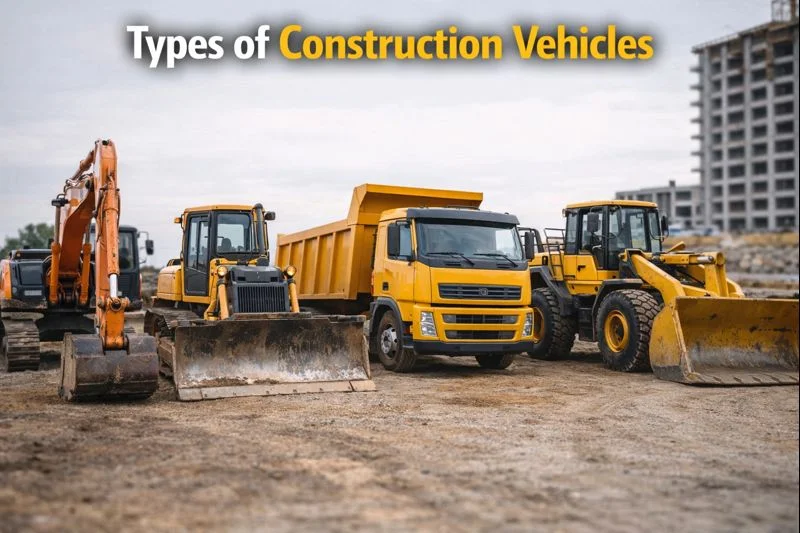
Excavators are among the most versatile machines on a construction site. They feature a rotating cab, a long articulated arm, and a bucket designed for digging, trenching, and material handling. Their ability to rotate 360 degrees allows precise operation in tight spaces.
These machines are commonly used for foundation digging, trench creation, demolition, and material placement. Different bucket sizes and attachments expand their functionality.
Bulldozers
Bulldozers are built for pushing heavy material across short distances. Equipped with a wide blade at the front, they excel at clearing land, leveling soil, and moving debris.
Their tracked design provides excellent traction on uneven terrain, making them ideal for rough or muddy conditions where wheeled vehicles struggle.
Wheel Loaders
Wheel loaders use large front-mounted buckets to scoop and transport loose material such as gravel, sand, and soil. Unlike bulldozers, they are designed for carrying rather than pushing.
These vehicles are commonly used in material yards, road construction, and large excavation projects where quick loading is essential.
Backhoe Loaders
Backhoe loaders combine digging and loading functions into one machine. They feature a loader bucket at the front and a backhoe arm at the rear.
Their versatility makes them popular on smaller job sites, utility work, and urban construction where space is limited.
Hauling And Transportation Vehicles
Dump Trucks
Dump trucks transport loose material from one location to another. Their rear beds tilt to unload contents quickly and efficiently.
They are essential for moving excavated soil, demolition debris, and construction aggregates across job sites.
Articulated Dump Trucks
Articulated dump trucks are designed for off-road use. Their jointed frames allow better maneuverability over uneven terrain.
These vehicles are commonly found in mining, large-scale earthmoving, and infrastructure projects.
Concrete Mixer Trucks
Concrete mixer trucks transport freshly mixed concrete to construction sites. Rotating drums prevent the concrete from hardening during transit.
Timing is critical with these vehicles, as concrete must be poured before it begins to set.
Flatbed Trucks
Flatbed trucks carry construction materials, equipment, and prefabricated components. Their open beds allow for easy loading and unloading.
They are widely used for transporting steel beams, lumber, and machinery.
Lifting And Material Handling Vehicles
Cranes
Cranes are designed to lift heavy loads vertically and move them horizontally. They come in various forms, including tower cranes for high-rise construction and mobile cranes for flexible lifting needs.
Cranes play a critical role in placing steel, concrete panels, and large equipment.
Telehandlers
Telehandlers resemble forklifts with extendable booms. They are capable of lifting materials to elevated positions and reaching over obstacles.
Their versatility makes them useful on residential, commercial, and agricultural construction sites.
Forklifts
Forklifts move palletized materials across short distances. In construction, they are often used in warehouses or staging areas.
Different attachments allow forklifts to handle specialized loads.
Road Construction And Surface Equipment
Motor Graders
Motor graders use long blades to create smooth, level surfaces. They are essential in road construction and site preparation.
Their precision allows accurate grading before paving begins.
Asphalt Pavers
Asphalt pavers lay asphalt evenly across road surfaces. They distribute material and provide initial compaction before rollers finish the process.
These machines ensure consistent road quality and thickness.
Road Rollers
Road rollers compact soil, gravel, or asphalt to create stable surfaces. Different roller types apply vibration or static pressure.
Proper compaction prevents future settling and surface failure.
Milling Machines
Milling machines remove old asphalt or concrete surfaces. They prepare roads for resurfacing by grinding away damaged layers.
Recycled material can often be reused, improving efficiency.
Specialized Construction Vehicles
Trenchers
Trenchers dig narrow trenches for pipelines, cables, and drainage systems. They provide consistent depth and width.
These machines are common in utility installation projects.
Pile Drivers
Pile drivers install deep foundation elements by driving piles into the ground. They are essential for structures built on weak or unstable soil.
Their use ensures long-term structural stability.
Concrete Pump Trucks
Concrete pump trucks move liquid concrete through hoses to hard-to-reach areas. This improves placement accuracy and reduces labor.
They are especially useful in high-rise and large-scale pours.
Snow And Debris Clearing Vehicles
In certain regions, construction vehicles are adapted for snow removal or disaster cleanup. Plows, sweepers, and loaders restore access quickly.
These machines support infrastructure maintenance year-round.
How Construction Vehicles Are Chosen For Projects
Equipment selection depends on several factors, including project size, terrain, material type, and timeline. Large infrastructure projects require heavy-duty machines, while smaller developments benefit from compact, versatile equipment.
Efficiency, fuel consumption, and maintenance needs also influence decisions. Modern construction increasingly favors machines that balance power with environmental considerations.
Technology And Safety Advancements
Modern construction vehicles include advanced safety systems, operator assistance features, and telematics. These technologies improve productivity while reducing accidents.
Remote monitoring allows contractors to track usage, maintenance schedules, and performance data.
Common Misconceptions About Construction Vehicles
Many people assume bigger machines always mean faster work. In reality, matching the right vehicle to the task is far more important than size.
Another misconception is that construction vehicles are simple machines. Modern equipment integrates sophisticated electronics and hydraulics.
Recognizing these factors helps explain why professional operators and planning matter.
Environmental Considerations And Future Trends
Manufacturers are developing electric and hybrid construction vehicles to reduce emissions and noise. These machines are increasingly used in urban environments.
Automation and semi-autonomous operation are also shaping the future of construction equipment.
Final Thoughts
Construction vehicles are purpose-built machines designed to perform specific tasks with precision, strength, and reliability. From earthmoving and hauling to lifting and finishing, each category plays a vital role in transforming plans into physical structures. The diversity of construction vehicles reflects the complexity of modern building projects, where efficiency and accuracy matter as much as raw power.
Choosing the right construction vehicle is not about size or popularity. It is about matching capability to task, environment, and timeline. As technology advances, these machines continue to evolve, becoming safer, more efficient, and more specialized. Together, they form the mechanical workforce that makes modern construction possible.

- How Families in UAE Manage Changing Vehicle Needs - March 4, 2026
- How Many Axles On A Car And What They Do - March 2, 2026
- Metal Shavings In Oil Causes And What It Means - March 2, 2026