
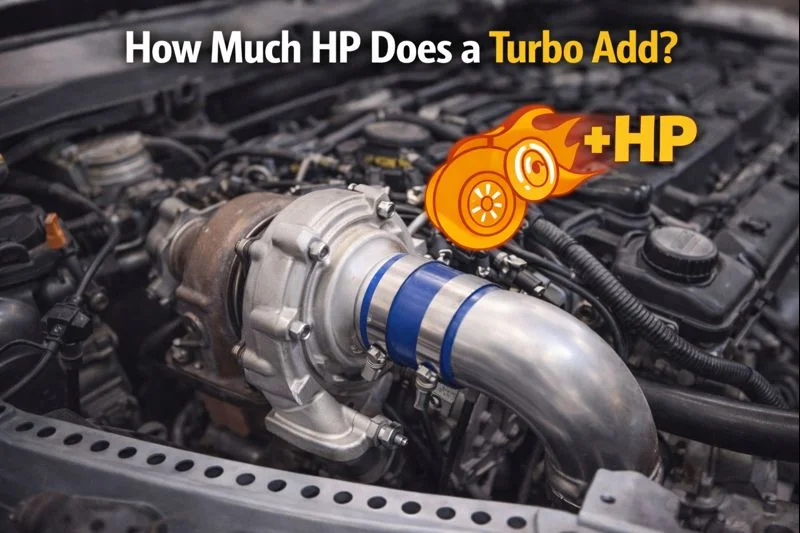
Turbochargers have transformed how engines make power. Once reserved for racing and high-performance builds, turbocharging is now common in everyday vehicles, from small hatchbacks to full-size trucks.
The appeal is simple: more horsepower without increasing engine size. Still, one question comes up more than any other when people talk about turbos. How much horsepower does a turbo actually add? The answer is not as straightforward as a single number.
Turbo gains depend on engine design, boost pressure, fuel system capacity, tuning quality, and supporting hardware.
Some engines gain modest increases that improve efficiency and drivability, while others see dramatic jumps that completely change how the vehicle performs. Expectations often become unrealistic when turbocharging is treated like a bolt-on shortcut to massive power.
In reality, a turbo works as part of a system, not a standalone upgrade. Looking closely at how a turbo adds horsepower, how much gain is typical, and what limits those gains helps set clear, realistic expectations before any modifications begin.
Table of Contents
How A Turbocharger Adds Horsepower
Using Exhaust Energy Instead Of Wasting It
A turbocharger uses exhaust gases to spin a turbine. That turbine is connected to a compressor wheel that forces more air into the engine. More air allows more fuel to be burned, which creates more power.
Instead of letting exhaust energy escape unused, a turbo recycles it to increase output.
Increased Air Density Inside The Engine
By compressing incoming air, a turbo increases air density. Denser air means more oxygen in each combustion cycle.
More oxygen supports more fuel, and more fuel creates a stronger combustion event.
Relationship Between Boost And Power
Boost pressure, measured in psi or bar, directly influences horsepower gain. Higher boost usually means more power, but only if the engine can safely handle it.
Every engine has a practical limit where reliability becomes a concern.
Typical Horsepower Gains From A Turbo
Small Turbo On A Naturally Aspirated Engine
A mild turbo setup on a naturally aspirated engine often adds 30 to 70 percent more horsepower. For example, a 150-horsepower engine may gain an additional 45 to 100 horsepower depending on boost and tuning.
These setups focus on drivability rather than extreme output.
Factory Turbocharged Engines
Factory turbo engines are already designed for forced induction. Increasing boost slightly through tuning can add 10 to 30 percent more horsepower without hardware changes.
Manufacturers leave a safety margin that tuners can tap into carefully.
Performance-Oriented Turbo Builds
High-performance turbo builds can double or even triple stock horsepower. These results require extensive supporting modifications and careful tuning.
Such builds are not typical daily-driver setups and demand higher maintenance.
Factors That Determine How Much HP A Turbo Adds
Engine Strength And Design
Engine internals such as pistons, rods, and crankshaft determine how much boost an engine can handle. Stronger components support higher horsepower gains.
Engines designed for forced induction tolerate boost far better than naturally aspirated designs.
Boost Pressure Levels
Low boost provides modest gains with high reliability. High boost increases horsepower rapidly but also raises heat and stress.
Balancing boost pressure with engine durability is critical.
Fuel System Capacity
Adding air without adding fuel does not increase power safely. Injectors, fuel pumps, and fuel lines must support the increased demand.
Insufficient fueling limits horsepower and risks engine damage.
Engine Management And Tuning
Proper tuning controls fuel delivery, ignition timing, and boost levels. A well-tuned turbo setup produces more usable power than a poorly tuned high-boost system.
Tuning quality often matters more than turbo size.
Cooling And Intake Efficiency
Intercoolers reduce intake air temperature, improving power and reliability. Cooler air is denser and less prone to detonation.
Efficient intake and exhaust flow also influence overall gains.
Realistic Power Examples
Small Four-Cylinder Engines
A naturally aspirated four-cylinder engine producing 130 horsepower may reach 180 to 220 horsepower with a moderate turbo setup.
This range maintains drivability and fuel efficiency when tuned correctly.
Six-Cylinder Engines
Six-cylinder engines often respond very well to turbocharging. A 250-horsepower engine may reach 350 horsepower with conservative boost.
The additional displacement helps manage airflow and heat.
Large Displacement Engines
Large engines can gain significant horsepower from turbos, but gains are often limited by traction and drivetrain strength rather than airflow.
A turbo on a large engine focuses more on torque delivery than peak numbers.
Why Turbo Size Matters
Small Turbo Characteristics
Small turbos spool quickly, providing faster response and strong low-end torque. Horsepower gains are moderate but very usable.
These setups suit daily driving and street use.
Large Turbo Characteristics
Large turbos support higher peak horsepower but take longer to spool. Power delivery is aggressive once boost builds.
These setups are better suited for track or performance-focused builds.
Matching Turbo Size To Engine Goals
Choosing the right turbo balances response, power, and reliability. Oversized turbos often disappoint in real-world driving.
A matched setup delivers better results than chasing peak numbers.
Supporting Modifications That Affect HP Gains
Exhaust System Improvements
A free-flowing exhaust reduces backpressure and allows the turbo to operate more efficiently.
Better exhaust flow often increases horsepower without raising boost.
Intercooler Upgrades
Larger or more efficient intercoolers lower intake temperatures. This supports higher boost and more consistent power.
Heat management becomes critical as horsepower increases.
Internal Engine Upgrades
Forged pistons and rods allow higher boost levels safely. These upgrades increase potential horsepower but add cost and complexity.
They are essential for extreme builds.
Reliability Versus Maximum Horsepower
Conservative Turbo Setups
Lower boost levels extend engine life and reduce maintenance needs. Power gains are still noticeable and enjoyable.
Many daily drivers use this approach successfully.
Aggressive Turbo Setups
Pushing boost aggressively increases horsepower but also increases wear. Frequent maintenance and careful monitoring become necessary.
Reliability trade-offs should be considered carefully.
Common Misconceptions About Turbo Horsepower
Many believe a turbo adds a fixed amount of horsepower. In reality, gains vary widely.
Another misconception is that more boost always equals more power. Without proper support, increased boost can reduce reliability and performance.
Understanding these points helps avoid costly mistakes.
Fuel Type And Its Role In Power Gains
Regular Versus Premium Fuel
Higher-octane fuel resists detonation better under boost. This allows more aggressive tuning and higher horsepower.
Most turbo setups perform best on premium fuel.
Alternative Fuels
Ethanol blends support higher boost and cooler combustion. These fuels allow larger horsepower gains but require fuel system upgrades.
Fuel choice directly affects potential output.
Turbocharging And Daily Usability
Drivability Changes
Turbocharging often increases torque more than peak horsepower. This makes vehicles feel stronger in everyday driving.
Proper tuning ensures smooth power delivery.
Fuel Economy Considerations
Light throttle operation can maintain or even improve efficiency. Heavy boost usage increases fuel consumption.
Driving habits influence real-world results.
Long-Term Maintenance And Costs
Increased Heat And Wear
Turbo systems generate additional heat. Oil quality and cooling become more important.
Regular maintenance protects engine health.
Component Lifespan
Turbos, hoses, and seals wear over time. Proper installation and care extend lifespan.
Budgeting for maintenance avoids surprises.
When A Turbo Is Not The Right Choice
Some engines respond poorly to turbocharging due to design limitations. In these cases, naturally aspirated upgrades may provide better results.
Vehicle usage and goals should guide modification decisions.
Final Thoughts
A turbocharger can add anywhere from 30 percent to well over 100 percent more horsepower, depending on engine design, boost level, and supporting modifications. There is no universal number because turbocharging works as a system rather than a single upgrade. Conservative setups deliver reliable gains that enhance daily driving, while aggressive builds unlock extreme performance at the cost of complexity and maintenance.
The most successful turbo builds focus on balance rather than peak figures. Matching turbo size, boost pressure, fuel delivery, and tuning quality creates usable, dependable power. When approached thoughtfully, a turbo does far more than add horsepower. It reshapes how an engine performs, delivering stronger acceleration, improved efficiency, and a driving character that feels entirely transformed.

- How Families in UAE Manage Changing Vehicle Needs - March 4, 2026
- How Many Axles On A Car And What They Do - March 2, 2026
- Metal Shavings In Oil Causes And What It Means - March 2, 2026