
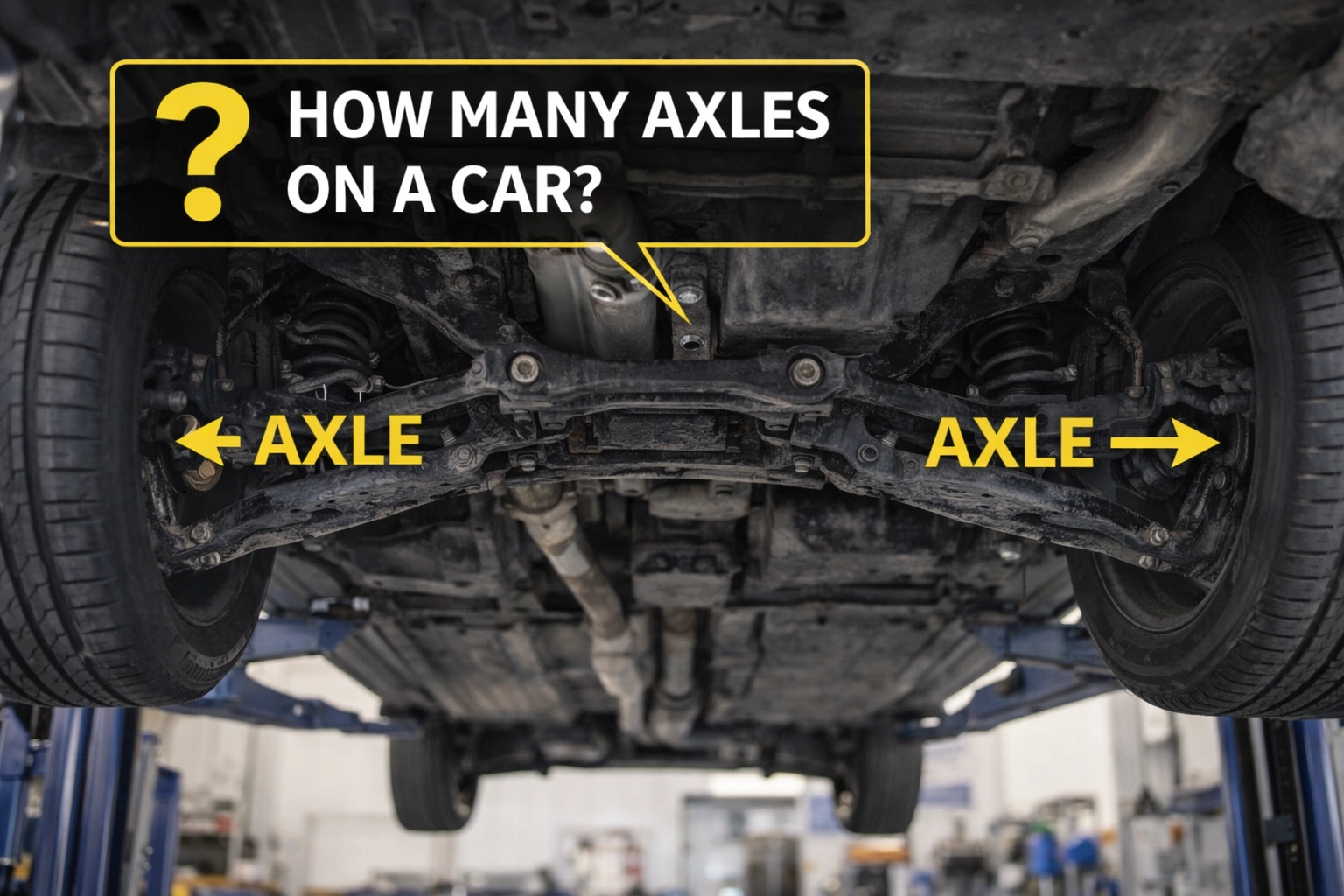
Every vehicle on the road relies on a set of hidden components that quietly handle weight, rotation, and power transfer. Among those parts, axles play a central role. They connect wheels, support the vehicle’s weight, and in many cases deliver engine power to the ground. Most drivers rarely think about axles unless something goes wrong, yet they are fundamental to safe movement.
The number of axles on a car depends on its design and purpose. In standard passenger vehicles, the answer is simple. However, once you look at trucks, commercial vehicles, and specialty platforms, the configuration becomes more varied. Axles influence stability, load capacity, and drivetrain layout. Recognizing how many axles a vehicle has and what each one does helps clarify how power flows from the engine to the pavement and how weight is distributed across the chassis.
Table of Contents
Standard Axle Count In Passenger Cars
Most Cars Have Two Axles
A typical passenger car has two axles. One axle connects the front wheels, and another connects the rear wheels. Regardless of whether the vehicle is front wheel drive, rear wheel drive, or all wheel drive, the total axle count in a standard car remains two.
Vehicles such as the Toyota Corolla and Honda Accord follow this two axle layout. Each axle supports two wheels, meaning most passenger cars have four wheels and two axles.
The front axle usually handles steering duties, while the rear axle supports stability and load distribution. Even though both axles exist physically, only one may deliver engine power depending on drivetrain configuration.
This two axle structure provides balance between simplicity and performance.
Difference Between Drive Axles And Non Drive Axles
Not every axle in a car delivers power. In a front wheel drive vehicle, the front axle is the drive axle because it transfers engine torque to the wheels. The rear axle in that case simply supports the vehicle and allows wheels to rotate freely.
In rear wheel drive vehicles, the rear axle becomes the drive axle. The front axle handles steering but does not transmit engine power.
All wheel drive vehicles use both axles to distribute torque.
For example, the Subaru Outback sends power to both front and rear axles.
Understanding this distinction clarifies how different drivetrains function with the same axle count.
Axle Types Based On Drivetrain Design
Front Wheel Drive Configuration
Front wheel drive vehicles use a transaxle that combines the transmission and differential into a single unit. This design powers the front axle directly.
The rear axle in these vehicles often consists of a simpler beam or independent suspension system without a differential.
This layout reduces weight and improves fuel efficiency. Many modern sedans and compact SUVs use this setup.
Vehicles like the Hyundai Elantra commonly rely on front wheel drive architecture.
Although there are still two axles, only the front axle receives engine power.
Rear Wheel Drive Configuration
Rear wheel drive vehicles transmit power from the engine through a driveshaft to the rear differential, which splits torque between rear wheels.
The front axle focuses on steering and suspension support.
This configuration is common in performance vehicles and trucks.
Models such as the Ford Mustang use rear wheel drive for balanced handling and strong acceleration characteristics.
The total axle count remains two, but their roles differ from front wheel drive systems.
Axle Count In Larger Vehicles
Trucks And Commercial Vehicles
While passenger cars typically have two axles, larger vehicles may have more. Pickup trucks often still have two axles, but heavy duty trucks can feature three or more.
For example, a Ford F-350 Super Duty may include a dual rear wheel configuration on a single rear axle. Even with four rear wheels, it still counts as one rear axle.
Commercial trucks used for freight may include additional axles to support heavier loads.
Extra axles increase weight capacity and improve load distribution.
Six Wheel And Multi Axle Vehicles
Vehicles with six wheels often have three axles. Military vehicles and specialized off road trucks sometimes use this configuration for enhanced stability.
Each axle supports two wheels, meaning more wheels require additional axles.
More axles allow better weight distribution across the chassis.
Passenger vehicles rarely exceed two axles unless heavily modified.
Recognizing wheel count helps estimate axle count accurately.
Why Axle Count Matters
Axle count affects weight distribution, braking performance, and legal load limits. More axles allow vehicles to carry heavier loads without exceeding road regulations.
In passenger cars, two axles provide sufficient support for typical weight ranges.
Axle configuration also influences suspension design and handling behavior.
Proper maintenance of axle components such as CV joints and bearings ensures safe operation.
Although most cars have two axles, their design and function vary depending on drivetrain layout and vehicle purpose.
Most standard passenger cars have two axles: one front and one rear. Depending on drivetrain type, either axle may serve as the drive axle, while the other supports steering or stability. Larger trucks and specialty vehicles may include additional axles for increased load capacity.
Understanding axle count clarifies how vehicles distribute power and weight. Even though the number remains simple for most cars, the engineering behind those axles plays a major role in overall performance and safety.

- How Families in UAE Manage Changing Vehicle Needs - March 4, 2026
- How Many Axles On A Car And What They Do - March 2, 2026
- Metal Shavings In Oil Causes And What It Means - March 2, 2026