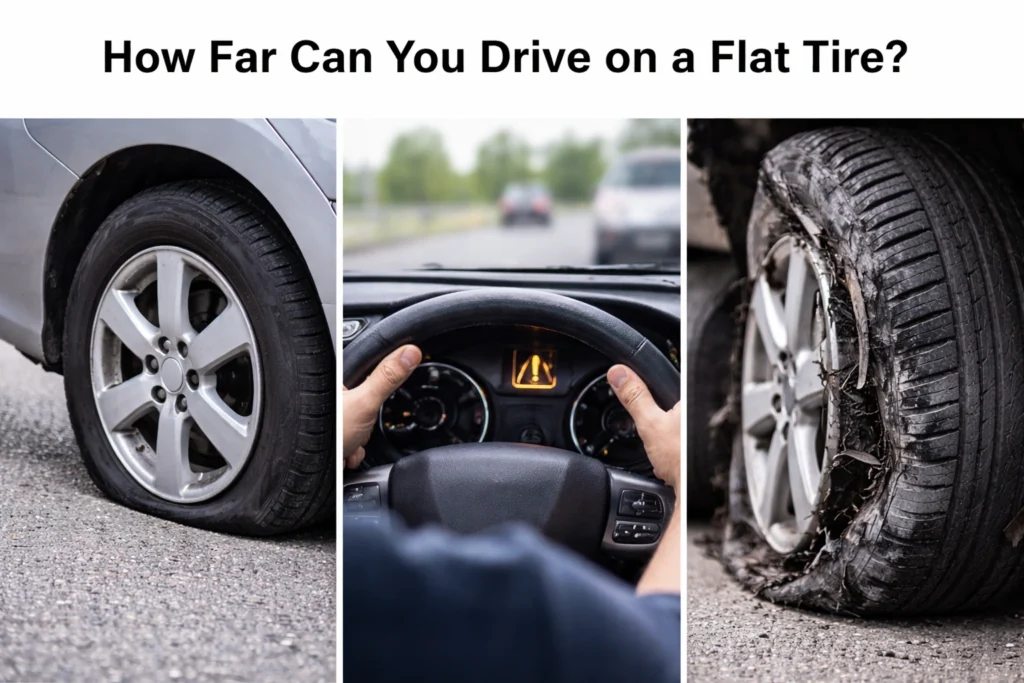
A flat tire instantly changes priorities. Momentum, schedules, and convenience disappear, replaced by a single pressing question: how far can the vehicle still go without causing serious harm?
Many drivers face this moment unexpectedly, whether on a busy highway, a quiet back road, or far from roadside assistance. The temptation to keep moving “just a little farther” is strong, especially when a safe stopping point seems close.
Tires are engineered to support weight using air pressure, not solid structure. Once that pressure disappears, everything changes.
The tire, wheel, suspension, and even braking system begin absorbing forces they were never designed to handle. Damage does not happen gradually or predictably. It accelerates with speed, load, and distance.
Clear, practical guidance matters in these moments. Distance limits depend on tire type, vehicle weight, speed, and road conditions. Some tires tolerate limited movement better than others, while some situations demand immediate stopping.
Knowing what truly happens when a car moves on a flat tire helps drivers make safer decisions and avoid turning a simple tire issue into an expensive repair or dangerous situation.
Table of Contents
What Happens When A Tire Loses Air
A tire’s structure depends on air pressure to maintain shape and strength. Without it, internal forces change immediately.
Loss Of Structural Support
Air pressure keeps the tire’s sidewalls upright and the tread evenly supported. When air escapes, the sidewalls collapse inward.
The tire no longer distributes weight evenly. Instead, the sidewalls and inner liner absorb direct contact with the road.
Rapid Heat Buildup
As the tire flexes abnormally, friction increases. Heat builds quickly, especially at higher speeds.
Heat weakens rubber compounds and internal cords, accelerating failure.
Sidewall And Bead Damage
The sidewall is the weakest part of the tire. Driving on it causes creasing, cracking, and internal cord breakage.
Once sidewall damage occurs, the tire becomes unsafe to repair.
Wheel And Suspension Stress
With no cushion from air pressure, impacts transfer directly to the wheel and suspension.
Bent rims, damaged bearings, and alignment issues become real risks.
How Far You Can Drive On A Flat Tire
There is no safe long-distance answer, but realistic limits exist.
Standard Tires With No Air
With a fully deflated standard tire, distance should be measured in feet, not miles.
In most cases, driving more than a few hundred yards causes irreversible tire damage. Even short distances can destroy the sidewall.
Extremely Short Emergency Movement
If stopping immediately creates danger, such as in active traffic, moving at walking speed to a safer shoulder may be necessary.
This movement should be slow, smooth, and as brief as possible.
Effect Of Speed On Distance
Speed multiplies damage. At higher speeds, heat and sidewall collapse occur almost instantly.
Driving faster does not increase safe distance. It reduces it dramatically.
Load And Vehicle Weight Influence
Heavier vehicles crush flat tires more aggressively.
SUVs, trucks, and fully loaded vehicles cause faster internal failure than lighter cars.
Differences Between Tire Types
Not all tires respond the same way to air loss.
Conventional Tires
Most vehicles use conventional tires. These rely entirely on air pressure.
Once flat, they offer almost no tolerance for continued driving.
Run-Flat Tires
Run-flat tires are reinforced to support limited movement without air.
Many are designed to travel roughly 50 miles at reduced speed, typically under 50 mph. Exact limits depend on manufacturer design.
Low-Profile Performance Tires
Low-profile tires have short sidewalls.
They provide less protection when deflated and suffer damage faster than taller tires.
Off-Road And Heavy-Duty Tires
Some off-road tires have stronger sidewalls.
Even so, driving on them while flat still causes damage and should be minimized.
Signs That Driving Must Stop Immediately
Certain warnings mean continued movement is unsafe.
Loud Flapping Or Grinding Sounds
These noises indicate the tire is disintegrating or the wheel is contacting the road.
Continuing risks wheel damage and loss of control.
Steering Pull Or Vibration
A strong pull to one side or severe vibration signals structural collapse.
Control becomes unpredictable at this point.
Smoke Or Burning Smell
Heat buildup can cause rubber to burn.
This creates fire risk and complete tire failure.
Visible Rim Contact
If the rim touches the ground, damage is already occurring.
Further movement risks bending or cracking the wheel.
Damage That Occurs From Driving On A Flat Tire
Even short distances can create costly consequences.
Tire Destruction Beyond Repair
Most flat-driven tires cannot be repaired.
Sidewall damage makes them unsafe for future use.
Wheel Damage
Aluminum wheels bend easily under direct load.
Steel wheels resist bending better but still suffer deformation.
Suspension And Alignment Issues
Sudden impacts transfer force into suspension components.
Struts, control arms, and bushings may shift or wear prematurely.
Brake And Hub Stress
Braking on a damaged wheel increases stress on hubs and rotors.
Long-term reliability may be affected.
Why Continuing To Drive Is So Risky
The danger goes beyond repair cost.
Loss Of Vehicle Control
A collapsed tire reduces steering and braking effectiveness.
Emergency maneuvers become unpredictable.
Blowout Risk
Partial air loss often turns into complete failure under load.
A sudden blowout at speed is extremely dangerous.
Damage Escalation
Each rotation worsens internal destruction.
What starts as a tire issue can quickly involve wheels, suspension, and safety systems.
What To Do Immediately After A Flat Tire Occurs
Correct response minimizes risk and expense.
Slow Down Gradually
Abrupt braking increases instability.
Reduce speed smoothly and activate hazard lights.
Find The Safest Stopping Area
Prioritize wide shoulders, parking areas, or flat ground.
Avoid curves, hills, or blind spots.
Inspect The Tire Visually
Look for visible damage, air loss, or rim contact.
This helps decide whether a spare or roadside assistance is required.
Avoid Guessing Distance
Assuming “just a mile” is safe often leads to major damage.
When unsure, stop.
Spare Tires And Temporary Solutions
Temporary options exist but have limits.
Full-Size Spare Tires
These function like regular tires.
Normal speeds and distances are generally acceptable until repair or replacement.
Temporary Compact Spares
Compact spares are lighter and narrower.
Speed and distance limits are usually printed on the tire, often around 50 mph.
Tire Sealant And Inflation Kits
Sealants may temporarily seal small punctures.
They do not fix sidewall damage or large leaks.
Special Situations And Considerations
Some conditions require extra caution.
Driving In Remote Areas
Remote travel increases the temptation to keep moving.
Carrying a spare and tools becomes especially important.
Night Or Poor Visibility Conditions
Visibility challenges increase stopping risk.
Extra care is required when choosing a stopping location.
Heavy Traffic Scenarios
Traffic pressure should never override safety.
Moving slowly to a safer area is acceptable, but distance must remain minimal.
How Far Is Too Far In Practical Terms
Real-world limits matter.
Zero Miles Is The Ideal Answer
The safest distance on a flat tire is none.
Stopping immediately prevents almost all damage.
A Few Car Lengths For Safety
Moving a short distance to clear danger is sometimes necessary.
This should be done at the lowest possible speed.
Beyond That Is Damage Territory
Once movement extends beyond emergency positioning, damage becomes likely.
Costs escalate quickly with each additional rotation.
Preventive Steps To Avoid Flat Tire Emergencies
Preparation reduces stress and risk.
Regular Tire Pressure Checks
Proper inflation reduces blowout risk.
Pressure loss often precedes complete flats.
Tire Condition Inspection
Cracks, bulges, and uneven wear increase failure risk.
Early replacement prevents roadside emergencies.
Carrying Emergency Equipment
A spare tire, jack, and basic tools provide options.
Roadside assistance coverage adds security.
Common Myths About Driving On Flat Tires
Misconceptions lead to bad decisions.
“Slow Driving Prevents Damage”
Even slow speeds damage sidewalls.
Heat and collapse still occur.
“The Tire Looks Fine Afterward”
Internal damage is often invisible.
A tire that appears intact may be structurally compromised.
“It Will Hold Until The Shop”
Distance assumptions rarely match reality.
Tire failure often happens sooner than expected.
Financial Impact Of Driving On A Flat Tire
Costs rise quickly.
Tire Replacement
Most flat-driven tires require replacement rather than repair.
Premium tires increase expense.
Wheel Repair Or Replacement
Bent or cracked wheels add significant cost.
Some damage is not repairable.
Secondary Repairs
Alignment, suspension, and brake repairs may follow.
What began as a simple puncture becomes a larger bill.
Final Thoughts
A flat tire leaves little room for compromise. Tires are designed to operate with air, and once that air is gone, their ability to carry weight disappears almost instantly. Distance tolerance on a flat tire is extremely limited, often measured in yards rather than miles. Speed, vehicle weight, and tire design all influence how quickly damage occurs, but none eliminate the risk.
Moving briefly to escape immediate danger can be justified. Continuing beyond that point almost guarantees tire destruction and invites wheel, suspension, and safety system damage. The safest approach remains simple: slow down, stop as soon as possible, and address the issue properly.
In the long run, stopping early protects both the vehicle and the people inside it. When it comes to flat tires, restraint is not inconvenience—it is the smartest form of control.

- How Families in UAE Manage Changing Vehicle Needs - March 4, 2026
- How Many Axles On A Car And What They Do - March 2, 2026
- Metal Shavings In Oil Causes And What It Means - March 2, 2026