
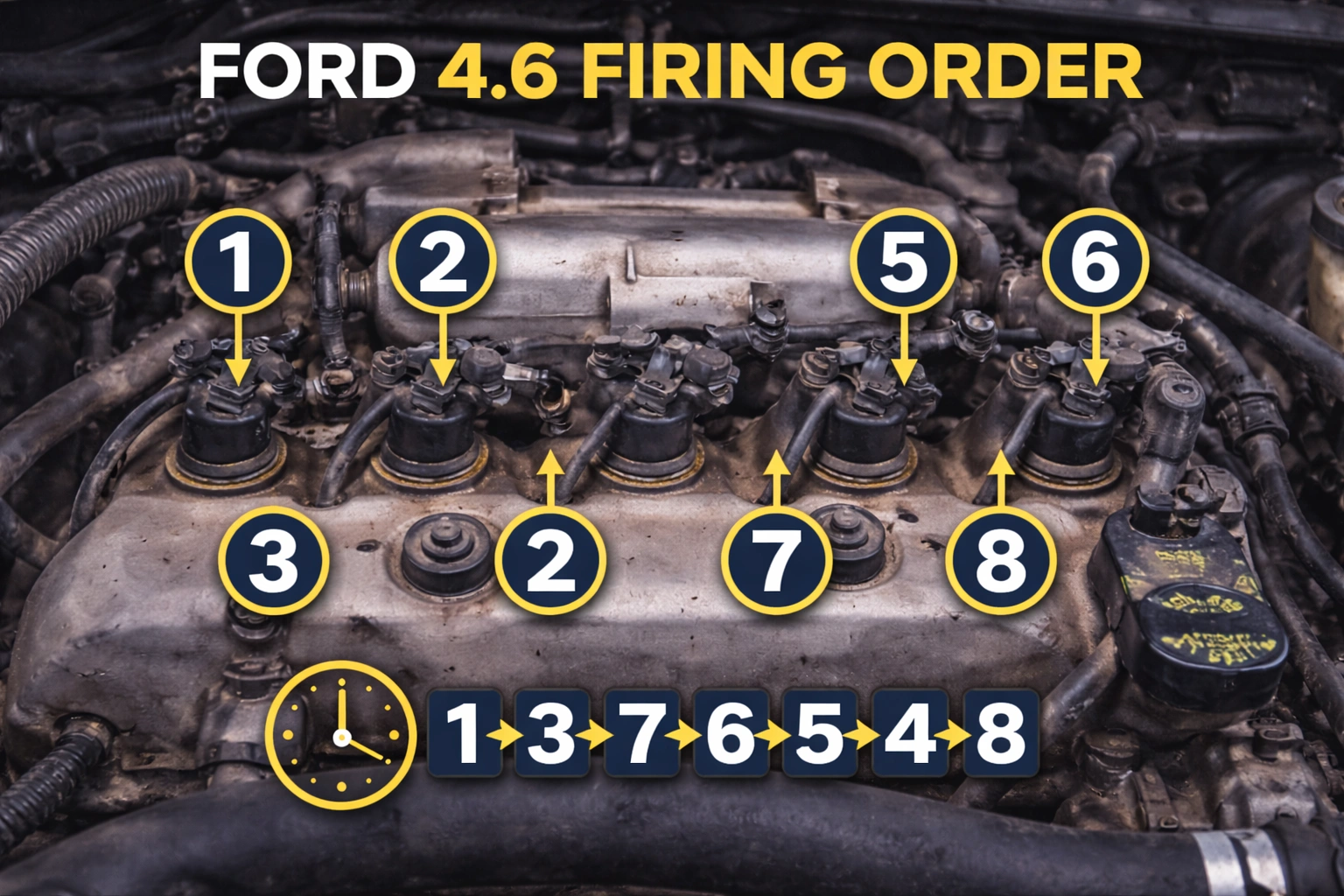
The Ford 4.6-liter V8 became one of the most widely used engines in Ford’s modern lineup. Found in Mustangs, Crown Victorias, F-150 trucks, Expeditions, and several Lincoln and Mercury models, it built a reputation for durability and smooth operation. Unlike older pushrod small-block engines, the 4.6 belongs to Ford’s modular engine family, featuring overhead camshaft design and electronic ignition control.
Even with its modern layout, the firing order remains a critical detail during repairs, ignition diagnostics, and coil replacement. When spark delivery follows the wrong sequence, the engine can misfire, run rough, lose power, or fail to start altogether. Because this engine uses coil-on-plug ignition instead of a traditional distributor, confusion often arises about how firing order applies.
The firing order determines the sequence in which each cylinder receives spark. Knowing the correct order, cylinder numbering, and coil layout ensures accurate diagnosis and smooth engine performance.
Table of Contents
Understanding Cylinder Numbering On The Ford 4.6
Cylinder Bank Layout And Position Identification
The Ford 4.6 V8 is arranged in a 90-degree V configuration. When facing the engine from the front of the vehicle, the passenger-side bank is considered Bank 1, and the driver-side bank is Bank 2.
Cylinder numbering follows a front-to-back pattern. On the passenger side, cylinders are numbered 1 through 4 starting at the front. On the driver side, cylinders are numbered 5 through 8, again beginning at the front and moving toward the firewall.
This layout is important when diagnosing misfires. For example, a code referencing cylinder 3 corresponds to the third cylinder back on the passenger side. Misidentifying cylinder position leads to incorrect coil or plug replacement.
Accurate cylinder identification forms the foundation for proper firing order confirmation.
Why Cylinder Identification Matters During Repairs
Modern engines rely on precise electronic timing. Each cylinder fires at a specific point in crankshaft rotation. If a technician replaces ignition coils or spark plugs without confirming cylinder numbering, problems may persist despite new components.
While coil-on-plug systems eliminate the need for routing spark plug wires in sequence, firing order still governs how the engine control module triggers ignition events.
Understanding cylinder placement helps trace misfires accurately and ensures maintenance tasks align with factory design.
The Correct Firing Order For The Ford 4.6
Standard Firing Sequence
The firing order for the Ford 4.6 modular V8 is:
1-3-7-2-6-5-4-8
This sequence applies to most naturally aspirated and many performance versions of the 4.6 engine. It reflects crankshaft journal design and camshaft configuration within the modular architecture.
Each number represents the order in which spark is delivered to that cylinder during engine rotation. Even though the engine does not use a traditional distributor, the electronic ignition system follows this exact pattern internally.
The firing sequence balances crankshaft load and reduces vibration by alternating firing events between banks in a controlled pattern.
Relationship Between Crankshaft Design And Firing Order
The 4.6 uses a cross-plane crankshaft. Cross-plane V8 engines typically use firing orders designed to minimize vibration and distribute firing pulses evenly.
The sequence 1-3-7-2-6-5-4-8 alternates between banks in a manner that prevents consecutive firing in adjacent cylinders on the same bank. This reduces stress on crankshaft bearings and improves smoothness at idle.
Proper sequencing is not random. It is engineered to optimize balance, durability, and combustion efficiency.
Coil On Plug System And How Firing Order Still Applies
Electronic Ignition Instead Of Distributor Wiring
Unlike older engines that required spark plug wires to be routed in correct order around a distributor cap, the Ford 4.6 uses individual ignition coils mounted directly above each spark plug.
The engine control module determines when each coil fires based on crankshaft and camshaft position sensors. Although physical wiring order is no longer visible, the internal ignition sequence remains identical to the traditional firing order.
When a misfire occurs, diagnostic codes identify the affected cylinder. The control module continues firing other cylinders in sequence while isolating the problematic one.
Common Confusion During Coil Replacement
Because there are no plug wires to route manually, some assume firing order does not matter. However, replacing coils without verifying cylinder location may lead to confusion if multiple misfire codes appear.
For example, swapping coils between cylinders can help confirm whether a coil is faulty. If a misfire moves with the coil, the component is defective.
Tracking cylinder numbers carefully ensures accurate troubleshooting and prevents unnecessary part replacement.
Timing, Camshaft Variations, And Performance Considerations
Single Overhead Cam And Dual Overhead Cam Variants
The Ford 4.6 engine exists in both single overhead cam and dual overhead cam configurations. Despite these design differences, the firing order remains the same in most applications.
Dual overhead cam versions often produce higher power due to improved airflow, but ignition sequencing remains consistent.
This consistency simplifies service procedures across various 4.6-powered vehicles.
Aftermarket Modifications And Custom Tuning
Performance modifications such as aftermarket camshafts or forced induction setups do not typically change the firing order. However, ignition timing curves may be adjusted during tuning.
Electronic tuning software allows fine-tuning of spark advance, but cylinder sequence remains fixed based on mechanical crankshaft design.
Verifying tuning parameters after modifications ensures combustion events occur at correct timing intervals.
Diagnosing Misfires Related To Ignition Sequence
Symptoms Of Firing Related Problems
When firing events occur incorrectly, the engine may run unevenly. Symptoms include rough idle, hesitation under acceleration, reduced fuel efficiency, and illuminated check engine lights.
Modern onboard diagnostics identify specific cylinder misfires. Codes such as P0301 through P0308 indicate which cylinder is misfiring.
Addressing ignition components promptly prevents catalytic converter damage and maintains performance.
Systematic Troubleshooting Approach
Effective troubleshooting begins by confirming cylinder location. Inspect spark plugs for wear, examine ignition coils for cracks, and check wiring connectors for corrosion.
If multiple cylinders misfire, checking crankshaft position sensor signals becomes important.
Repair expenses depend on the specific component involved. Replacing a single ignition coil generally costs less than addressing sensor or wiring harness failures. Early diagnosis prevents larger repair bills later.
Maintenance Practices For Reliable Operation
Spark Plug Replacement Intervals
The Ford 4.6 engine often uses long-life spark plugs, but replacement intervals should follow manufacturer recommendations. Worn plugs increase coil stress and may lead to premature ignition component failure.
Proper torque during installation prevents thread damage in aluminum cylinder heads.
Using correct plug type ensures stable combustion and smooth operation.
Monitoring Engine Performance Over Time
Periodic scanning for stored codes, even without warning lights, helps detect early ignition irregularities.
Smooth idle, steady acceleration, and consistent fuel economy indicate healthy firing operation.
Maintaining ignition components supports overall engine reliability and prevents cascading issues.
Bottom Line
The Ford 4.6 firing order is 1-3-7-2-6-5-4-8. This sequence governs how the engine control module triggers ignition events in a balanced pattern designed to optimize smoothness and durability.
Although the engine uses a coil-on-plug system rather than a traditional distributor, cylinder numbering and firing order remain essential for accurate diagnostics and maintenance.
Careful identification of cylinder positions, timely spark plug replacement, and proper ignition system inspection keep the 4.6 operating as intended. Following the correct firing sequence ensures reliable combustion and long-term engine performance.

- How Families in UAE Manage Changing Vehicle Needs - March 4, 2026
- How Many Axles On A Car And What They Do - March 2, 2026
- Metal Shavings In Oil Causes And What It Means - March 2, 2026
