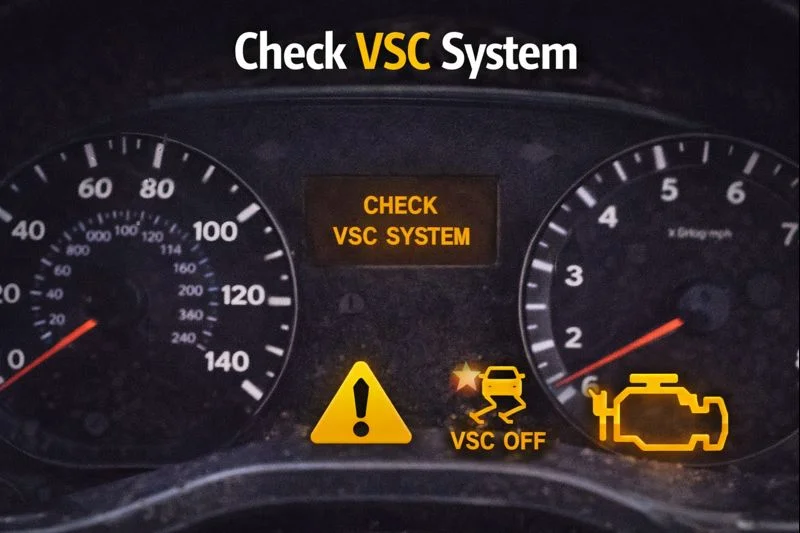
Modern vehicles rely heavily on electronic safety systems to keep control during sudden maneuvers, slippery roads, or emergency braking. One of the most important of these systems is the Vehicle Stability Control system, commonly shown as “VSC.”
When a dashboard message says “Check VSC System,” it often creates confusion because the car may still drive normally. There may be no strange noises, no loss of power, and no obvious handling problems.
This makes many drivers unsure whether the warning is serious or something that can wait. The VSC system works quietly in the background and only intervenes when the vehicle begins to lose traction or stability.
When the warning appears, it means the system has detected a fault and has likely shut itself off as a precaution. This does not always mean a major failure, but it does mean that one or more components are not communicating correctly.
Knowing what the VSC system does, what triggers the warning, and how the issue is diagnosed helps drivers respond correctly without panic or unnecessary expense.
Table of Contents
What The VSC System Does In Everyday Driving
Role Of Vehicle Stability Control
Vehicle Stability Control helps keep the car moving in the intended direction during sharp turns, sudden lane changes, or slippery conditions. It works by monitoring wheel speed, steering angle, yaw rate, and throttle input.
If the system senses loss of control, it can reduce engine power or apply braking to individual wheels.
Relationship With Traction Control And ABS
VSC works closely with traction control and the anti-lock braking system. These systems share sensors and control modules.
A problem in one system can trigger warnings for others.
When The System Activates
Under normal conditions, VSC stays inactive. It steps in only when wheel slip or skidding is detected.
Most drivers never notice it unless conditions are poor.
Common Reasons The Check VSC System Warning Appears
Faulty Wheel Speed Sensors
Wheel speed sensors track how fast each wheel rotates. Dirt, corrosion, or sensor failure can send incorrect data.
When data does not match expectations, the system disables itself.
Steering Angle Sensor Issues
The steering angle sensor tells the system where the driver intends to go. If this sensor loses calibration or fails, stability calculations become unreliable.
This often triggers a warning after battery replacement or alignment.
Brake System Problems
Low brake fluid, worn brake components, or ABS issues can interfere with VSC operation.
Since braking is a key part of stability control, brake faults often disable VSC.
Engine Or Throttle Faults
The VSC system may reduce engine power to regain control. If the engine control system has a fault, VSC cannot intervene properly.
This is why engine warning lights sometimes appear together with the VSC warning.
Electrical Or Wiring Issues
Damaged wiring, weak battery voltage, or poor ground connections can disrupt sensor signals.
Electrical problems are common but often overlooked.
Warning Signs That May Appear Alongside The VSC Message
Traction Control Light
The traction control indicator often illuminates at the same time as the VSC warning.
This signals that traction assistance is also disabled.
ABS Light
Because ABS and VSC share components, an ABS warning may appear as well.
This combination usually points to sensor or hydraulic issues.
Reduced Engine Power
Some vehicles enter a limited power mode when stability control faults occur.
This protects the system but affects performance.
No Noticeable Driving Change
In some cases, the only symptom is the warning message itself.
This does not mean the issue should be ignored.
How Serious Is A Check VSC System Warning
Normal Dry Road Conditions
On dry roads with careful driving, the vehicle may feel normal. Basic braking and steering still function.
However, stability assistance is unavailable.
Slippery Or Emergency Situations
Without VSC, the car is more likely to skid or spin during sudden maneuvers.
This increases risk during rain, snow, or emergency braking.
Long-Term Driving With The Warning
Driving for extended periods without addressing the issue is not recommended.
Underlying faults can worsen and lead to additional system failures.
Initial Steps To Take When The Warning Appears
Check The Gas Cap
On some vehicles, a loose gas cap can indirectly trigger system warnings due to emissions-related faults.
This is a quick and simple check.
Restart The Vehicle
Occasionally, temporary sensor glitches clear after restarting.
If the warning returns, further action is needed.
Inspect Battery Condition
Low battery voltage can confuse electronic systems.
Weak batteries often cause multiple warning lights.
Observe Other Warning Lights
Noting which lights appear together helps narrow down the cause.
Patterns matter in diagnosis.
Diagnostic Process For VSC System Issues
Scanning For Trouble Codes
A diagnostic scan retrieves stored fault codes. These codes point to specific sensors or systems.
Generic scans may not show all stability-related data.
Interpreting The Codes
Codes indicate whether the issue involves sensors, wiring, or control modules.
Proper interpretation prevents unnecessary part replacement.
Visual And Physical Inspection
Technicians inspect sensors, wiring, and connectors for damage or corrosion.
Road debris and moisture often cause sensor issues.
Calibration Checks
Some components require recalibration after repairs or alignment.
Skipping calibration can keep the warning active.
Repair Options And Typical Cost Ranges
Sensor Replacement
Wheel speed and steering angle sensors are common repair items. Costs vary based on location and labor.
Replacing sensors usually resolves the issue.
Brake System Repairs
Brake-related fixes include fluid replacement, ABS module repair, or component replacement.
Costs increase with system complexity.
Wiring And Electrical Repairs
Repairing damaged wiring may be time-consuming but prevents repeat failures.
Electrical issues require careful diagnosis.
Control Module Replacement
In rare cases, the stability control module itself fails. This is among the most expensive repairs.
Module failure is less common than sensor faults.
Why The Warning Sometimes Clears On Its Own
Temporary sensor interference, moisture, or voltage drops can trigger brief warnings.
Once conditions normalize, the system may resume operation.
However, recurring warnings indicate unresolved problems.
Driving Safety Tips When VSC Is Disabled
Reduce Speed In Poor Conditions
Without stability assistance, cautious driving becomes more important.
Lower speeds reduce risk.
Avoid Sudden Steering Inputs
Smooth steering minimizes loss of control.
Abrupt movements increase danger.
Increase Following Distance
Extra space allows more time to react without relying on electronic aids.
Defensive driving becomes essential.
Preventing VSC System Issues In The Future
Regular Brake Maintenance
Healthy brakes support stability control performance.
Brake neglect affects multiple systems.
Keeping Sensors Clean
Periodic inspection of wheel sensor areas helps prevent contamination.
Clean sensors provide accurate data.
Battery And Charging System Care
Strong electrical supply ensures reliable system communication.
Voltage stability matters.
Addressing Warning Lights Promptly
Early diagnosis prevents cascading failures.
Small issues grow when ignored.
Common Misunderstandings About The Check VSC System Message
Many assume the car is unsafe to drive immediately. While caution is required, the vehicle usually remains drivable.
Another misconception is that the system itself is broken. Often, the warning reflects a related system fault.
Replacing random parts without diagnosis wastes money.
Model Differences And Sensitivity
Some vehicles are more sensitive to sensor irregularities due to system design.
Earlier generations may display warnings more frequently.
Later models improved fault detection accuracy.
When Professional Help Is Necessary
If the warning remains after basic checks or appears with multiple warning lights, professional diagnosis is recommended.
Advanced scanning tools provide deeper insight.
Repeated resets without repair do not solve the problem.
Final Thoughts
The Check VSC System warning is an important safety alert rather than a simple notification. It indicates that the vehicle’s stability assistance is unavailable due to a detected fault. While the car may continue to drive normally, critical electronic safety features are no longer active. In many cases, the cause is something manageable such as a sensor issue, low battery voltage, or brake-related fault.
Prompt diagnosis and repair restore full safety functionality and prevent related systems from being affected. Treating the warning seriously, even when the car feels fine, ensures better control during emergencies and protects long-term reliability. Stability control is designed to assist when it matters most, and keeping it operational is essential for safe driving.

- How Families in UAE Manage Changing Vehicle Needs - March 4, 2026
- How Many Axles On A Car And What They Do - March 2, 2026
- Metal Shavings In Oil Causes And What It Means - March 2, 2026