
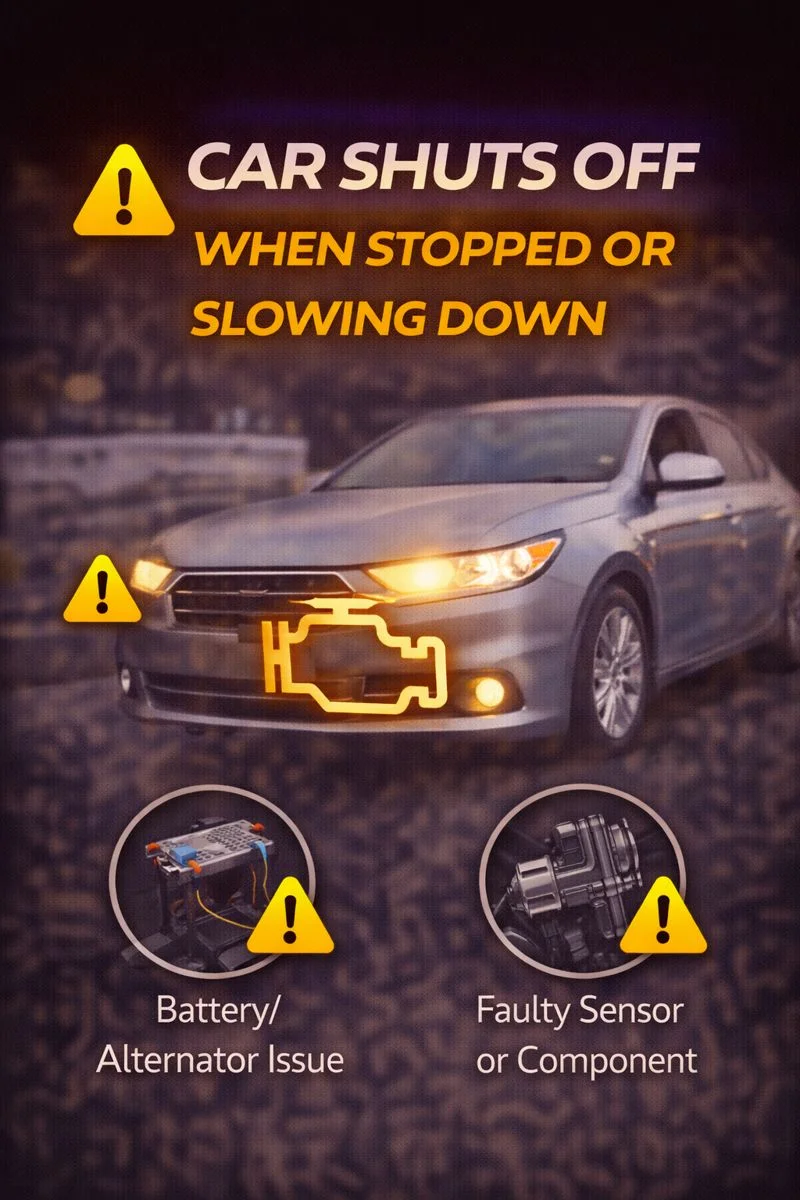
A car that runs fine at speed but shuts off when you slow down or come to a stop creates instant stress. It may happen at traffic lights, during parking maneuvers, or while rolling toward a junction.
The engine feels smooth while moving, then suddenly drops off as soon as your foot leaves the accelerator. Restarting is often easy, which makes the problem even more confusing. Many drivers keep going, hoping it was a one-time glitch, until it happens again in the worst possible moment.
This type of stalling is not random. Slowing down is one of the most delicate moments for an engine. Airflow drops, fuel delivery changes, and the engine must stabilize itself at idle. If even one system struggles during that transition, the engine can shut off quietly without warning lights or loud noises.
This guide breaks down why cars stall when stopping or slowing, which systems are usually involved, how to spot useful patterns, and what fixes actually solve the problem instead of masking it.
Table of Contents
Why Slowing Down Is Harder On The Engine Than Cruising
When a car is moving at steady speed, the engine operates under stable conditions. Airflow is consistent, fuel delivery is predictable, and engine speed stays above idle range.
As you slow down, several things happen at once. The throttle closes, engine speed drops, and control systems must quickly adjust airflow and fuel to keep the engine running smoothly. This transition happens in seconds.
If airflow control, fuel delivery, or sensor feedback is slow or inaccurate, engine speed can fall below the point needed to stay running. That is why stalling often happens right as the vehicle comes to a stop.
Idle Control System And Its Role At Stops
The idle control system is responsible for keeping the engine running when your foot is off the accelerator.
Older vehicles use an idle air control valve, while newer ones rely on electronic throttle control. Both systems regulate how much air enters the engine at idle.
When this system becomes dirty, sticks, or reacts slowly, the engine may not receive enough air as speed drops. The result is stalling at stop signs or during deceleration.
Idle control issues are among the most common causes of stalling when stopping.
Throttle Body Buildup And Airflow Restriction
The throttle body controls air entering the engine. Over time, carbon buildup forms around the throttle plate.
At cruising speed, this buildup has little effect. At idle, it becomes a problem because airflow is already minimal.
When you slow down, the throttle plate closes and the engine relies on small air passages to stay running. If those passages are restricted, airflow drops too far and the engine shuts off.
Cleaning the throttle body often restores stable idle immediately.
Vacuum Leaks That Show Up At Low Speed
Vacuum leaks allow unmetered air into the engine. This disrupts the air-fuel balance.
At higher speeds, the engine can often compensate. At idle or during slowing, the imbalance becomes severe.
Common vacuum leak sources include:
- Cracked hoses
- Loose fittings
- Intake gasket leaks
- Brake booster hose issues
Vacuum leaks frequently cause stalling at stops without affecting highway driving.
Fuel Delivery Issues At Idle
Fuel delivery must be precise at idle. Even small interruptions can cause stalling.
Dirty fuel injectors may deliver uneven fuel at low flow rates.
A weak fuel pump can struggle to maintain pressure when engine speed drops.
Fuel pressure regulators that respond slowly may cause brief fuel starvation during deceleration.
These problems often do not cause issues at speed, which is why they are overlooked.
Sensors That Influence Idle Stability
Several sensors play a direct role in idle behavior.
The mass airflow sensor measures incoming air. If it becomes dirty or inaccurate, fuel delivery at idle suffers.
The throttle position sensor informs the engine computer when the throttle closes. Incorrect signals can prevent idle control from engaging properly.
The coolant temperature sensor adjusts fuel mixture based on engine temperature. Incorrect readings can cause stalling when warm.
These sensors can fail gradually and intermittently.
Electrical And Voltage Stability Problems
At idle, electrical output is lower. If voltage drops too far, control systems may stop working properly.
Weak batteries, corroded terminals, or poor ground connections can cause brief power loss to sensors and control modules.
This often results in stalling when slowing down, especially with accessories running.
Electrical issues rarely trigger warning lights at first.
Load Changes During Braking And Steering
Stopping involves more than just slowing the engine.
Power steering, brake boosters, and climate systems add load at low engine speed.
If idle compensation is slow or inadequate, added load can stall the engine.
This is often noticed when turning the steering wheel while stopping or when the air conditioning is on.
Transmission-Related Causes In Automatic Vehicles
Automatic transmissions add load when shifting into lower gears or coming to a stop.
If idle speed is too low or torque converter behavior is abnormal, the engine may stall during deceleration.
Torque converter clutch issues can keep the transmission partially engaged when it should release, dragging engine speed down.
This type of stalling often feels abrupt and repeatable.
Exhaust And Emissions Components That Affect Idle
Exhaust-related problems can also cause stalling.
A stuck exhaust gas recirculation valve allows exhaust gases into the engine at idle when they are not needed.
This dilutes the air-fuel mixture and can shut the engine off during stopping.
Restricted exhaust flow can also create backpressure that interferes with idle stability.
Why The Engine Restarts Easily After Stalling
Restarting often feels normal because starting conditions are different from idle.
During cranking, fuel mixture is enriched and airflow is higher. Sensors reset, and control systems reinitialize.
This allows the engine to start even though the underlying issue remains.
As soon as idle conditions return, stalling may happen again.
Patterns That Help Identify The Cause
Noticing patterns saves time and money.
Consider:
- Does it happen only when warm?
- Does it happen with the air conditioning on?
- Does steering input make it worse?
- Does idle speed fluctuate before stalling?
These details point toward specific systems rather than guessing.
Why There May Be No Warning Lights
Many idle-related issues do not meet the criteria for triggering warning lights.
Mechanical airflow restrictions, vacuum leaks, and slow-reacting components often escape detection.
This creates a false sense of safety even though the problem is active.
Absence of warning lights does not equal absence of problems.
Simple Checks That Can Be Done Safely
Some checks are easy and safe to perform.
Inspect vacuum hoses for cracks or loose connections.
Check throttle body for visible buildup.
Listen for hissing sounds at idle.
Observe idle speed behavior when accessories are turned on.
These checks provide useful clues before deeper diagnosis.
Why Guessing And Replacing Parts Rarely Works
Many stalling issues share similar symptoms.
Replacing random sensors or components without diagnosis often wastes money.
Accurate repair depends on identifying why the engine cannot stabilize at idle.
A focused approach always costs less in the long run.
When Professional Diagnosis Becomes Important
If basic checks do not reveal the cause, professional diagnosis helps.
Technicians can monitor live data, test idle control response, and measure fuel pressure accurately.
This confirms the exact failure instead of guessing.
Professional testing often reveals small issues before they become major repairs.
How Stalling Problems Usually Progress
Stalling often starts occasionally and becomes more frequent.
The engine may stall only when warm, then anytime you stop.
Eventually, starting may become harder or warning lights may appear.
Early repair prevents escalation.
Risks Of Ignoring Stalling When Slowing Down
Stalling in traffic increases risk.
Loss of power steering and brake assist, even briefly, affects control.
Repeated stalling strains the starter and battery.
Ignoring the issue rarely leads to improvement.
Repairs That Commonly Fix The Problem
Common effective fixes include:
- Throttle body cleaning
- Vacuum leak repair
- Idle control service
- Sensor replacement when confirmed faulty
- Fuel system cleaning
- Electrical connection repair
The correct fix depends on diagnosis, not symptoms alone.
Preventing Idle Stalling In The Future
Routine maintenance keeps idle systems clean.
Addressing small changes early prevents breakdowns.
Keeping electrical connections clean protects control systems.
Stable idle reflects a healthy engine.
Final Thoughts
A car that shuts off when stopped or slowing down is reacting to a breakdown in balance during the transition to idle. Airflow, fuel delivery, sensor feedback, and electrical stability all must work together in a narrow window. When one element falls behind, the engine can no longer hold itself up at low speed.
The most important step is taking the symptom seriously, even if restarting seems easy. Stalling is a warning that the engine is struggling during its most sensitive operating moment. Addressing the cause early restores smooth stops, prevents unsafe situations, and brings back confidence every time traffic slows.

- How Families in UAE Manage Changing Vehicle Needs - March 4, 2026
- How Many Axles On A Car And What They Do - March 2, 2026
- Metal Shavings In Oil Causes And What It Means - March 2, 2026