The Ford 351 Windsor is one of those engines that refuses to fade into history. Found in classic Mustangs, F-Series trucks, Broncos, and marine applications, it earned respect for its durability and torque-rich personality. Whether powering a weekend cruiser or a vintage workhorse, this small-block V8 remains popular among enthusiasts who value simplicity and mechanical reliability.
When tuning, rebuilding, or troubleshooting a 351 Windsor, one detail becomes critically important: the firing order. The firing order determines the sequence in which each cylinder ignites. If spark plug wires are installed incorrectly or the distributor is indexed wrong, the engine may run rough, backfire, or refuse to start altogether.
The 351 Windsor shares similarities with other Ford small-block engines, but its firing order differs from certain 302 configurations. Knowing the exact sequence and understanding how it relates to cylinder placement ensures proper ignition timing and smooth operation.
Table of Contents
Understanding Cylinder Numbering And Engine Layout
How Cylinders Are Positioned On The 351 Windsor
The 351 Windsor is a 90-degree V8 engine. Like most American V8 designs of its era, it has two cylinder banks. When facing the engine from the front of the vehicle, the passenger side bank is numbered 1 through 4, and the driver side bank is numbered 5 through 8.
This numbering pattern is critical when routing spark plug wires. Cylinder 1 sits at the front of the passenger side. Directly behind it is cylinder 2, followed by 3 and 4 toward the firewall. On the driver side, cylinder 5 begins at the front, followed by 6, 7, and 8.
Misidentifying cylinder positions is one of the most common reasons firing order corrections fail. Confirming cylinder layout visually before wiring ensures accuracy.
Why Firing Order Matters In A V8 Engine
A firing order is designed to balance engine vibration, distribute load evenly across crankshaft journals, and maintain smooth rotation. In a V8, proper sequencing prevents adjacent cylinders from firing consecutively in a way that stresses bearings or disrupts airflow.
The 351 Windsor uses a firing pattern engineered to optimize crankshaft balance and camshaft design. If spark timing occurs out of sequence, combustion events overlap improperly. The engine may shake, stall, or produce loud backfires through the intake or exhaust.
Correct firing order is essential for mechanical harmony within the engine.
The Correct Firing Order For The 351 Windsor
Official Firing Sequence
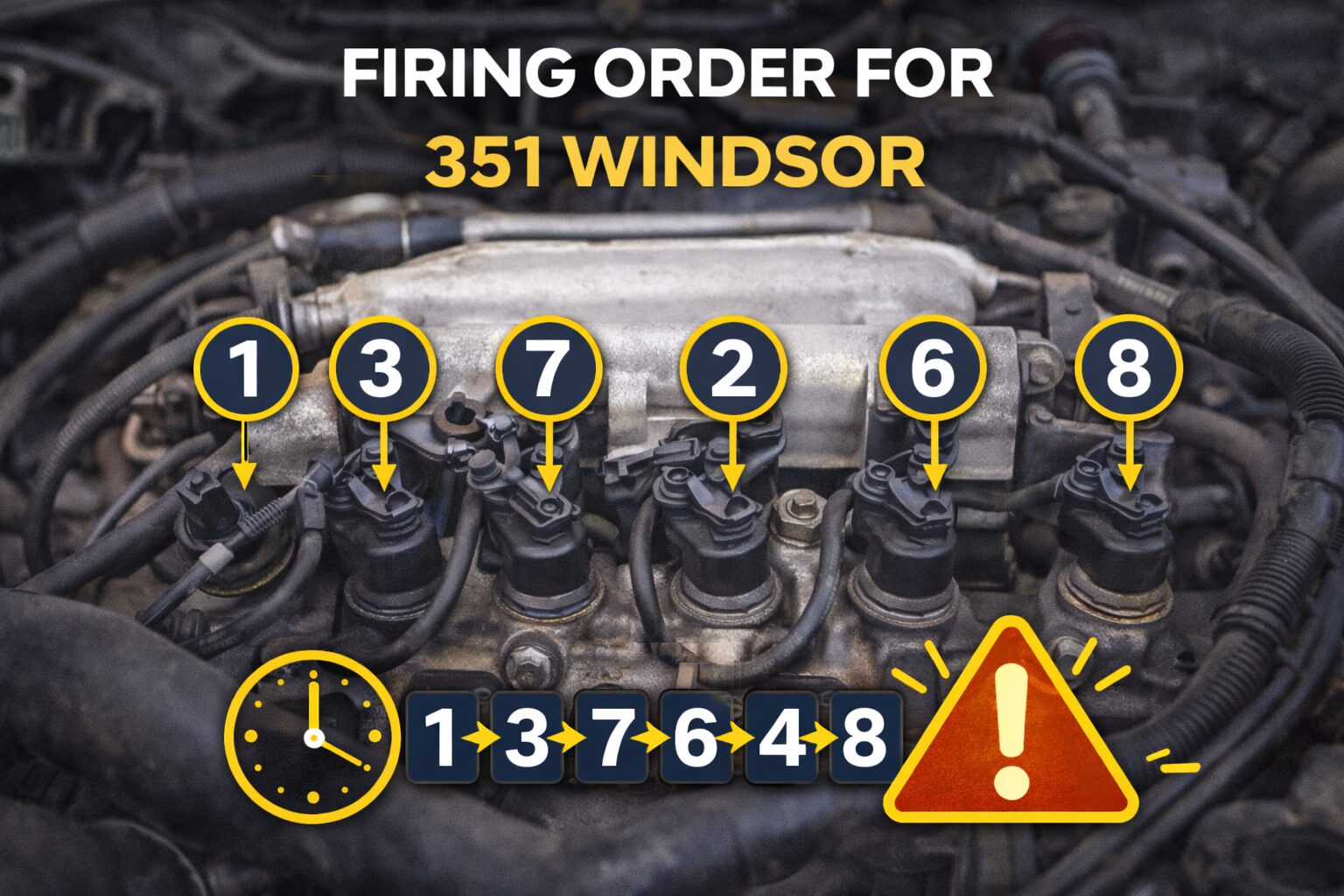
The firing order for the 351 Windsor is:
1-3-7-2-6-5-4-8
This sequence applies to standard factory camshaft configurations and most traditional builds unless a custom camshaft specifies otherwise.
Each number represents the cylinder that fires next in the rotation sequence. Spark must travel through the distributor cap in this order, following the rotor’s rotation direction.
Memorizing the sequence simplifies wiring and troubleshooting tasks.
Distributor Rotation Direction
The 351 Windsor distributor rotates counterclockwise. This detail is crucial when installing spark plug wires. After locating the number one terminal on the distributor cap, the remaining wires must follow the firing order in a counterclockwise direction around the cap.
Placing wires in clockwise order would reverse the sequence and prevent proper ignition timing.
Before installing wires, confirm top dead center on cylinder one during the compression stroke. This ensures the distributor rotor aligns correctly with the number one terminal.
Step By Step Guide To Wiring The Distributor Correctly
Locating Top Dead Center On Cylinder One
Setting the firing order begins with finding top dead center on cylinder one. Remove the spark plug from cylinder one and rotate the engine manually using a breaker bar on the crankshaft bolt.
Place a finger over the spark plug hole. As the piston rises during the compression stroke, pressure will build. Once pressure is felt and the timing mark aligns with zero on the harmonic balancer, the engine is at top dead center on compression.
At this position, the distributor rotor should point toward the number one terminal location.
Installing Spark Plug Wires In Proper Sequence
With cylinder one confirmed, connect the first wire from the distributor to cylinder one. Moving counterclockwise around the distributor cap, attach wires following the sequence 1-3-7-2-6-5-4-8.
Ensure each wire reaches the correct cylinder according to numbering layout. Routing wires cleanly and avoiding crossing where possible reduces interference and maintains tidy installation.
Double-checking each connection prevents misfires and repeated troubleshooting.
Common Mistakes When Setting Firing Order
Confusing 351 Windsor With 302 Firing Orders
Some Ford 302 engines use a different firing sequence depending on camshaft design. Installing a 302 firing pattern on a 351 Windsor causes immediate performance problems.
Although both engines share small-block architecture, their camshaft design determines ignition sequence.
Verifying engine displacement and camshaft specification eliminates confusion before wiring begins.
Distributor Installed One Tooth Off
If the distributor is installed one gear tooth off, ignition timing will be incorrect even if wires follow the proper sequence. The engine may crank but refuse to start.
Correcting distributor indexing involves removing and repositioning it so the rotor aligns properly at top dead center.
Proper alignment ensures base timing adjustments fall within specification.
Performance And Tuning Considerations
Aftermarket Camshaft Influence On Firing Order
Certain aftermarket camshafts for Ford small-block engines may specify alternative firing sequences. High-performance builds sometimes adopt the 351W firing pattern in 302-based engines for improved balance.
Before wiring, always confirm camshaft specifications. Installing wires according to factory pattern when using a custom cam can result in severe misfires.
Reading camshaft documentation ensures ignition sequence matches design.
Timing Adjustment After Wiring
Once wires are installed correctly, ignition timing must be set using a timing light. Base timing adjustments align spark delivery with crankshaft rotation.
Improper timing may produce pinging, sluggish acceleration, or overheating.
Setting timing accurately completes the ignition system setup and allows the engine to perform smoothly.
Diagnosing Issues Related To Incorrect Firing Order
Symptoms Of Miswired Spark Plug Cables
An incorrect firing order often results in rough idle, hesitation under throttle, or loud backfires. The engine may shake excessively or fail to maintain consistent RPM.
Fuel economy typically drops, and exhaust odor may become noticeable due to incomplete combustion.
Identifying these symptoms early prevents prolonged strain on engine components.
Systematic Troubleshooting Approach
When problems arise after wiring, verify cylinder numbering first. Then trace each spark plug wire from distributor to cylinder. Confirm counterclockwise rotation alignment.
If wiring checks out, verify distributor indexing and base timing.
Taking a methodical approach avoids unnecessary parts replacement.
Bottom Line
The 351 Windsor firing order is 1-3-7-2-6-5-4-8, with a counterclockwise distributor rotation. Correct cylinder identification and careful wire routing ensure smooth ignition timing and balanced engine operation.
Mistakes in sequence or distributor positioning lead to rough running and potential mechanical stress. Confirming top dead center and following the firing pattern carefully eliminates confusion during installation.
With proper setup, the 351 Windsor continues to deliver reliable V8 performance decades after its introduction.

- How Families in UAE Manage Changing Vehicle Needs - March 4, 2026
- How Many Axles On A Car And What They Do - March 2, 2026
- Metal Shavings In Oil Causes And What It Means - March 2, 2026