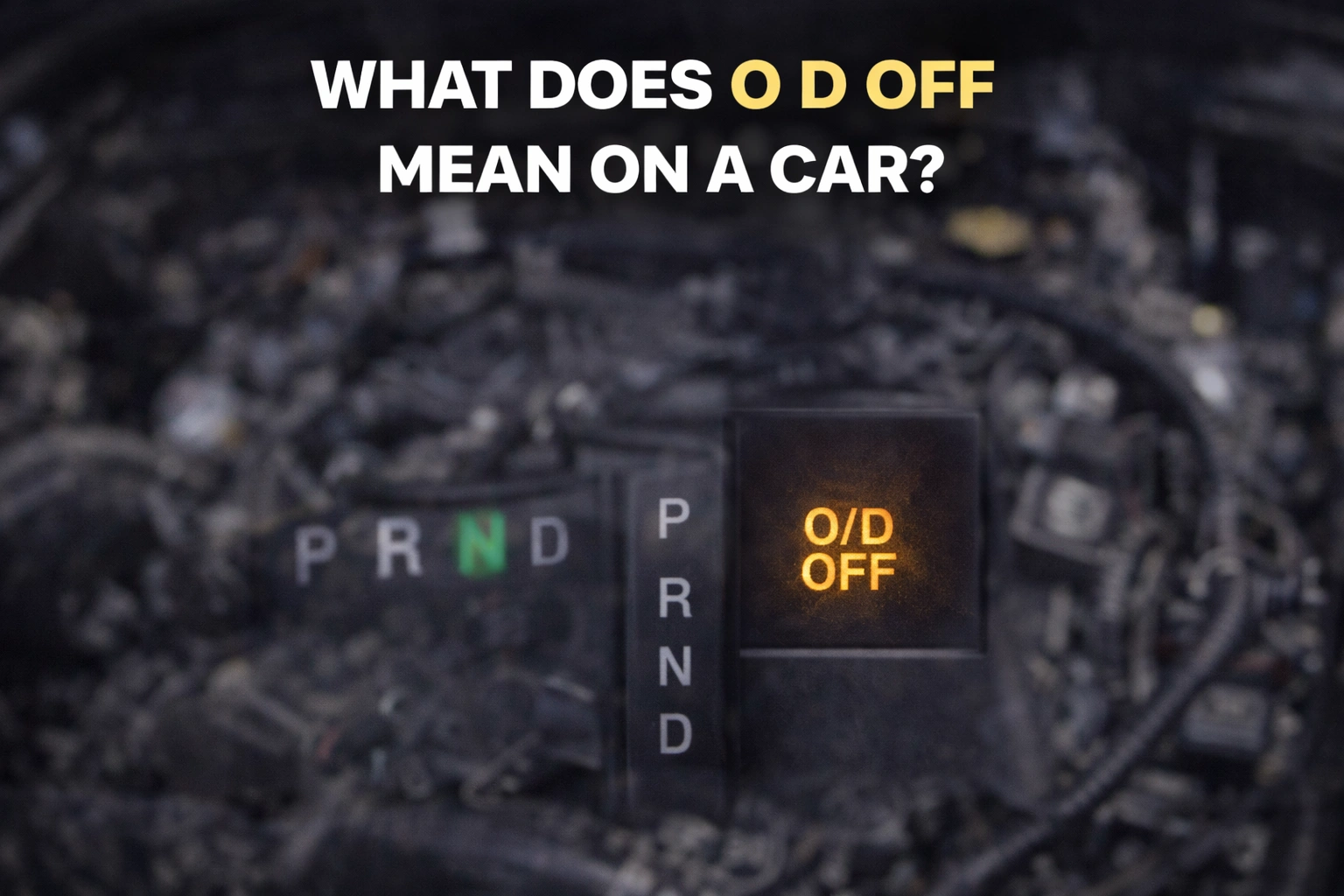
Automatic transmissions are designed to make driving simple. There is no clutch pedal, no manual gear selection in most cases, and no need to think about shift timing. Yet on many vehicles, a small button labeled “O/D” sits on the gear selector or steering column. Press it, and a light appears on the dashboard that reads “O D Off.” For many drivers, that indicator creates uncertainty.
Overdrive is a specific transmission gear designed for efficiency. It allows the engine to run at lower revolutions while maintaining higher road speeds. Turning it off changes how the transmission shifts, affecting engine speed, fuel use, and vehicle response.
The O D Off light does not signal damage. It simply confirms that the transmission’s highest gear has been disabled. Knowing when to use this feature—and when not to—can improve control, reduce strain in certain conditions, and protect transmission components during heavy load situations.
Table of Contents
What Overdrive Means In An Automatic Transmission
How Overdrive Gear Works Mechanically
Overdrive refers to the highest gear in many automatic transmissions. In this gear, the transmission output shaft rotates faster than the engine crankshaft. This creates a gear ratio below 1:1, which lowers engine RPM at cruising speeds.
Lower engine RPM means reduced internal friction, quieter operation, and improved fuel economy. At highway speeds, overdrive allows the vehicle to maintain steady motion without forcing the engine to spin excessively fast.
Mechanically, this gear reduces wear over long distances and helps maintain smooth operation. It is primarily designed for steady cruising on open roads rather than frequent acceleration or heavy load conditions.
The design improves efficiency during normal highway travel and is automatically selected by the transmission when appropriate.
What Happens When O D Off Is Activated
When the O D button is pressed and the dashboard shows O D Off, the transmission is prevented from shifting into its highest gear. It will continue to operate normally in lower gears but will not engage overdrive.
Engine RPM will remain slightly higher at highway speeds. This can increase fuel consumption but may provide more consistent power under certain conditions.
The system does not damage the vehicle. It simply modifies gear selection logic. Pressing the button again restores overdrive function and turns the indicator off.
The feature gives the driver limited manual control within an otherwise automatic system.
Situations Where Turning O D Off Is Beneficial
Towing Heavy Loads Or Pulling Trailers
Overdrive is designed for light load cruising. When towing a trailer or hauling heavy cargo, the engine requires more torque. In such situations, the transmission may shift repeatedly between overdrive and a lower gear while attempting to maintain speed.
Frequent shifting generates heat and increases transmission wear. Disabling overdrive keeps the transmission in a lower gear range, reducing gear hunting and improving stability.
Higher RPM allows the engine to maintain steady torque output without excessive strain. Many manufacturers recommend turning overdrive off during towing for improved control and longevity.
Using O D Off while towing reduces unnecessary transmission stress and promotes smoother power delivery.
Driving On Steep Hills Or Mountain Roads
When traveling uphill, the transmission may struggle to maintain speed in overdrive. The system may shift down repeatedly to maintain power, then shift back up once speed stabilizes. This constant cycling can feel jerky.
Turning off overdrive keeps the vehicle in a lower gear, improving engine braking on downhill slopes and maintaining stronger pull when climbing.
Engine braking helps control speed during long descents without excessive brake use. This reduces brake overheating risk.
In mountainous terrain, disabling overdrive enhances control and prevents repetitive gear changes that strain components.
Stop And Go Traffic At Moderate Speeds
In certain driving conditions where speeds fluctuate between city and lower highway ranges, overdrive engagement may not be consistent. While not always necessary, turning it off temporarily may reduce minor shifting transitions.
This situation varies by vehicle design. Some transmissions manage gear changes seamlessly without driver intervention.
O D Off is most useful when steady cruising conditions are not present and gear changes feel excessive.
How O D Off Affects Fuel Economy And Engine Behavior
Impact On Engine Speed And Noise
With overdrive active, engine RPM remains lower during steady cruising. Disabling it increases engine speed at the same road velocity.
Higher RPM may produce slightly louder engine sound and increased vibration, depending on vehicle design. While modern engines tolerate higher speeds safely, prolonged highway travel without overdrive may increase internal wear over time.
The effect is not immediate damage but gradual efficiency reduction. Overdrive is engineered to optimize long-distance operation.
Activating O D Off for extended highway driving is generally unnecessary unless specific load conditions require it.
Fuel Consumption Considerations
Fuel efficiency is closely tied to engine RPM. Lower RPM typically requires less fuel to maintain steady speed. Overdrive enhances this efficiency by reducing engine workload.
When O D Off is engaged at highway speeds, fuel consumption may increase modestly. For short distances, the difference is minimal. Over extended travel, the increase becomes more noticeable.
Balancing fuel economy with performance needs ensures optimal use of the feature.
Keeping overdrive active during normal highway driving preserves efficiency advantages.
Common Misconceptions About O D Off
O D Off Is Not A Transmission Warning
Many drivers assume that the O D Off light indicates a transmission problem. In most vehicles, it simply confirms the manual disabling of overdrive.
However, if the light begins flashing rather than remaining steady, it may indicate a transmission fault. A flashing indicator should prompt diagnostic scanning.
A steady O D Off light alone does not signal malfunction.
Distinguishing between solid and flashing indicators prevents unnecessary concern.
Driving With O D Off Will Not Immediately Damage The Vehicle
Some drivers worry that accidentally leaving O D Off activated may harm the transmission. In reality, the vehicle remains fully operational.
The transmission is designed to function in lower gears safely. The primary consequence is reduced fuel efficiency and slightly higher engine RPM.
Returning to normal operation is as simple as pressing the O D button again.
Short term use does not create mechanical harm.
Long Term Transmission Care And Best Practices
Use Overdrive For Steady Highway Travel
For everyday commuting and highway cruising, keeping overdrive enabled supports optimal efficiency and reduced wear.
Allow the transmission to shift automatically under light load conditions.
Manufacturers design overdrive for fuel savings and smooth operation during long distance travel.
Consistent use under proper conditions supports transmission longevity.
Disable Overdrive Strategically
Turn off overdrive when towing, climbing long grades, or descending steep hills where engine braking is beneficial.
Avoid frequent toggling unless road conditions change significantly.
Understanding when to apply the feature ensures it serves its intended purpose.
Selective use enhances control without compromising efficiency.
The Mechanical Perspective
O D Off means the transmission’s highest gear has been temporarily disabled. Overdrive is designed to lower engine RPM at cruising speeds, improving fuel efficiency and reducing wear. Turning it off keeps the engine operating in a lower gear range, which can be beneficial when towing, navigating hills, or managing heavy loads.
The feature does not indicate damage. It provides flexibility in specific driving conditions. Used correctly, it enhances control and protects transmission components from unnecessary shifting stress.
Keeping overdrive active during steady highway travel and disabling it only when conditions demand ensures balanced performance, efficiency, and long term reliability.

- How Families in UAE Manage Changing Vehicle Needs - March 4, 2026
- How Many Axles On A Car And What They Do - March 2, 2026
- Metal Shavings In Oil Causes And What It Means - March 2, 2026