
Dashboard lights are meant to communicate, but not all of them speak clearly. One of the most commonly misunderstood indicators is the one labeled “T C.” It may appear briefly when the car starts, flash while driving on a wet road, or stay on longer than expected.
For many drivers, those two letters raise questions rather than provide answers. Some assume it points to transmission trouble, others worry about engine damage, while many simply ignore it and keep driving.
The truth is far less dramatic but far more important. T C is tied directly to how a vehicle maintains control in situations where traction is limited. It works quietly in the background, stepping in only when the tires begin to lose grip.
When it behaves normally, most drivers never notice it. When it lights up, it is reacting to road conditions, driver input, or system status.
Knowing what T C means, how it operates, and why it activates helps drivers make sense of the warning without panic. It also clarifies when the light is doing exactly what it should and when it deserves attention.
Table of Contents
What T C Stands For In A Car
Meaning Of The T C Indicator
T C stands for Traction Control. It refers to a system designed to help prevent wheel spin during acceleration. When a vehicle begins to lose traction, especially on slippery surfaces, the traction control system intervenes to restore grip.
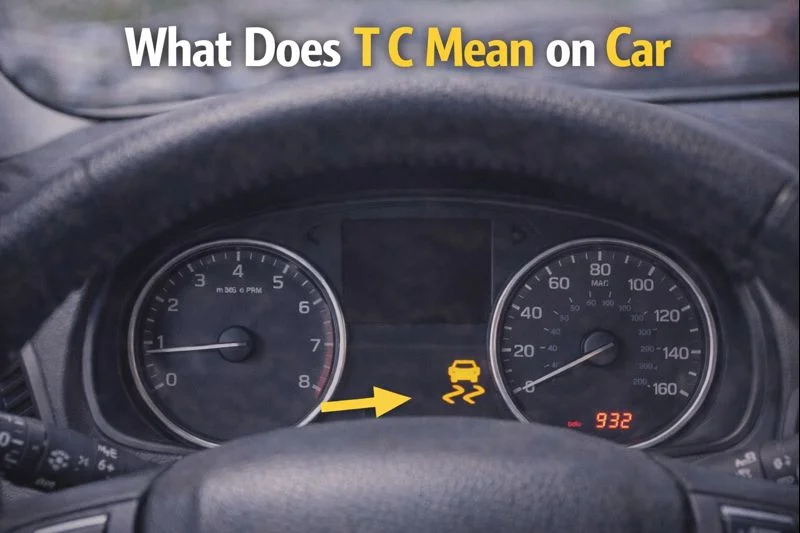
This indicator is usually represented by the letters “T C,” sometimes combined with a symbol of a car and wavy lines beneath it. The exact appearance varies by manufacturer, but the purpose remains the same.
Relationship To Stability And Safety Systems
Traction control is closely related to other safety systems such as electronic stability control and anti-lock braking. These systems share sensors and data to monitor wheel speed, steering angle, and vehicle movement.
Rather than acting alone, traction control operates as part of a broader network that helps keep the vehicle stable and predictable.
How Traction Control Works In Real Driving
Detecting Wheel Slip
Each wheel has a speed sensor that tracks how fast it is rotating. When one wheel spins faster than the others during acceleration, the system interprets this as a loss of traction.
This situation commonly occurs on wet pavement, loose gravel, snow, ice, or uneven road surfaces.
Reducing Power Or Applying Brakes
Once wheel slip is detected, traction control responds in one or both of the following ways. It may reduce engine power by limiting throttle input, or it may apply braking force to the spinning wheel.
By slowing the slipping wheel or redistributing power, the system helps the tire regain grip and keeps the vehicle moving forward smoothly.
Why Drivers Sometimes Feel A Brief Hesitation
When traction control activates, drivers may notice a brief hesitation or pulsing sensation. This is normal. It means the system is actively managing power to maintain control.
That momentary change in response is a sign of protection, not a fault.
When The T C Light Turns On Or Flashes
Light Flashing While Driving
A flashing T C light usually indicates active traction control intervention. This commonly happens during acceleration on slippery roads or during aggressive throttle input.
Once traction is restored, the light stops flashing and normal operation resumes.
Light Staying On Continuously
A solid T C light that remains on while driving often means the system has been turned off manually or is temporarily unavailable.
Some vehicles allow drivers to disable traction control using a dashboard button. When this happens, the light stays on as a reminder.
T C Light With Other Warning Indicators
If the T C light appears alongside a check engine light, ABS light, or stability control warning, it may indicate a system fault.
Because these systems share sensors, a problem in one area can affect multiple warnings.
Common Reasons The T C Light Appears
Slippery Road Conditions
Rain, snow, ice, mud, and gravel are the most common triggers. In these conditions, traction control activates frequently to manage wheel spin.
This is normal behavior and does not indicate a problem.
Aggressive Acceleration
Hard acceleration, especially from a stop, can cause brief wheel slip even on dry pavement. The system reacts instantly, causing the light to flash.
Performance-oriented vehicles with high torque may show this more often.
Manual Traction Control Deactivation
Many vehicles include a traction control off button. Drivers sometimes disable it intentionally for specific conditions, such as driving in deep snow or loose sand.
When disabled, the T C light remains on until the system is reactivated.
Sensor Or System Issues
Faulty wheel speed sensors, wiring problems, or control module issues can cause the T C light to stay on.
In these cases, traction control may be disabled as a precaution.
Difference Between T C And Stability Control
Traction Control Focus
Traction control primarily manages wheel spin during acceleration. Its goal is to maintain forward grip.
It works mostly in straight-line driving situations.
Stability Control Focus
Stability control manages overall vehicle direction. It intervenes when the car begins to skid or deviate from the intended path during cornering.
While separate in function, both systems rely on shared data and often activate together.
Is It Safe To Drive With The T C Light On
Short-Term Driving Considerations
If the T C light is on because the system was turned off manually, the car can still be driven. However, traction assistance will not be available if wheel slip occurs.
Extra caution is advised, especially in poor weather.
Driving With A System Fault
When the light stays on due to a fault, traction control is usually disabled. The car remains drivable, but stability assistance is reduced.
This increases the risk of wheel spin or loss of control in slippery conditions.
Situations Where Immediate Attention Is Needed
If multiple warning lights appear together or if handling feels unstable, professional inspection is recommended.
Ignoring system faults can compromise safety during emergency maneuvers.
How Traction Control Affects Performance
Impact On Acceleration
Traction control limits wheel spin, which can slightly reduce acceleration during hard launches.
This tradeoff favors control and safety over raw performance.
Why Performance Cars Allow T C Adjustment
Some vehicles allow partial or full traction control disablement to give drivers more control in specific conditions.
These options are intended for experienced drivers and controlled environments.
Common Myths About The T C Light
Many drivers assume T C stands for transmission control. While some vehicles use similar abbreviations for other systems, T C on the dashboard almost always refers to traction control.
Another misconception is that a flashing light means something is breaking. In reality, flashing usually means the system is actively helping.
Recognizing these myths prevents unnecessary worry.
Maintenance And Repair Related To Traction Control
Wheel Speed Sensor Replacement
Wheel speed sensors are one of the most common causes of traction control warnings. These sensors can fail due to dirt, corrosion, or impact damage.
Replacement costs are usually moderate and restore full system function.
Brake System Influence
Because traction control uses braking force, worn brake components or ABS issues can affect operation.
Maintaining the brake system supports traction control reliability.
Software Updates And Calibration
Some traction control issues are resolved through software updates or recalibration procedures.
Dealerships and specialized shops can perform these updates when needed.
When Turning Traction Control Off Makes Sense
Deep Snow Or Loose Terrain
In deep snow or sand, traction control can limit wheel spin too aggressively, making it harder to move.
Temporarily disabling the system allows controlled wheel spin to maintain momentum.
Performance Driving Scenarios
On closed tracks, experienced drivers may disable traction control to achieve specific handling characteristics.
This should never be done on public roads.
Long-Term Importance Of Traction Control
Traction control has contributed significantly to vehicle safety over the past decades. It reduces the likelihood of loss of control during acceleration and improves stability in unpredictable conditions.
While it does not replace careful driving, it adds an important layer of protection that works instantly and consistently.
Final Thoughts
T C on a car stands for traction control, a system designed to manage wheel slip and help maintain grip during acceleration. When the light flashes, it signals active assistance. When it stays on, it points to manual deactivation or a system issue that deserves attention.
Rather than being a cause for alarm, the T C indicator provides insight into how the vehicle is responding to road conditions and driver input. Knowing what it means removes confusion and allows better decision-making behind the wheel. When traction control is working properly, it operates quietly, stepping in only when needed. Paying attention to its signals helps keep control where it belongs, especially when conditions are less than ideal.

- How Families in UAE Manage Changing Vehicle Needs - March 4, 2026
- How Many Axles On A Car And What They Do - March 2, 2026
- Metal Shavings In Oil Causes And What It Means - March 2, 2026
