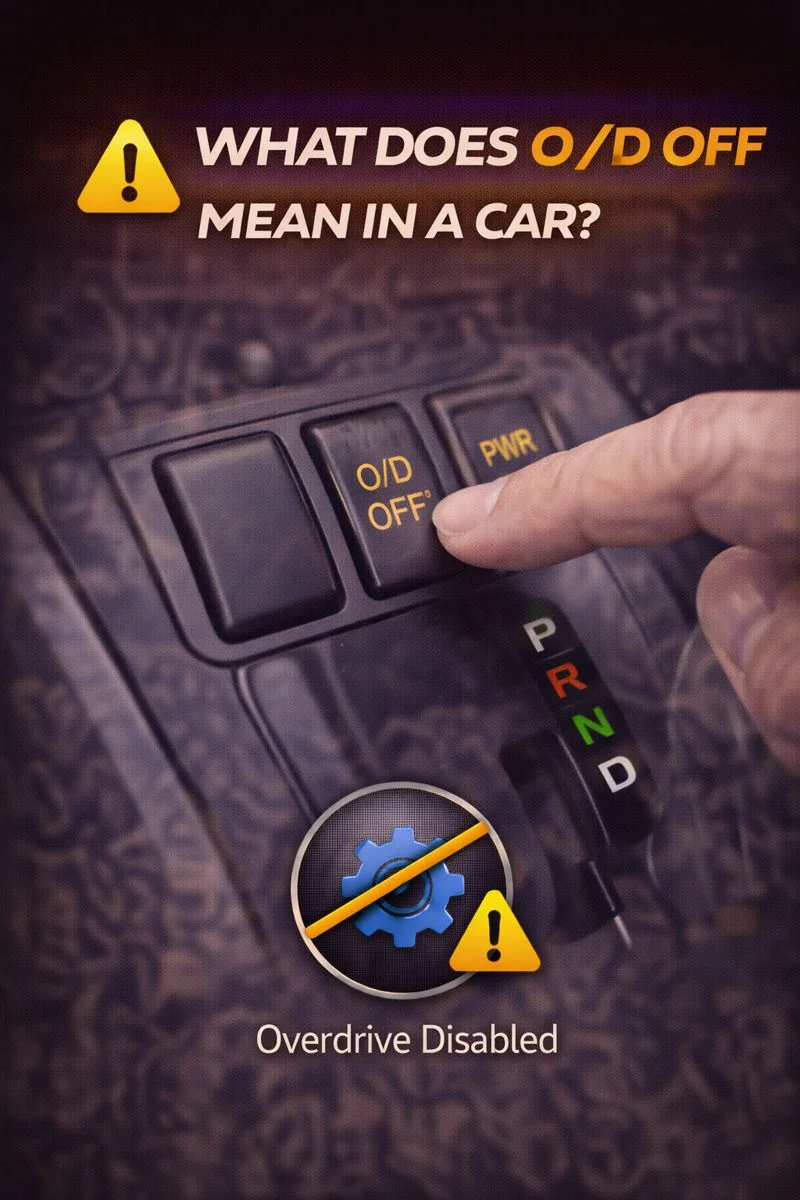
Many drivers notice the O D Off light on the dashboard or a button on the gear shifter and are never quite sure what it actually does. The car still moves, the transmission still shifts, and nothing seems broken, yet something clearly changes when that light turns on.
Some people think it is a warning. Others believe it improves performance. A few assume it should never be touched at all. In reality, O D Off is a normal transmission feature found in many automatic vehicles.
It is designed to give the driver more control over how the transmission behaves in specific situations. When used correctly, it can improve control, reduce unnecessary gear changes, and protect the transmission under stress.
When used incorrectly, it can reduce fuel economy and increase engine wear. This guide explains what O D Off means, what overdrive actually is, how the car behaves when it is turned off, and when it makes sense to use it in everyday driving.
Table of Contents
What Overdrive Means In Simple Terms
Overdrive is the highest gear in an automatic transmission.
It allows the engine to spin at a lower speed while the car maintains cruising speed. This reduces fuel consumption, engine noise, and wear during highway driving.
In overdrive, the transmission gear ratio is set so the engine turns fewer times than the driveshaft. This makes cruising smoother and more efficient.
Most modern automatic cars engage overdrive automatically when driving at steady speeds.
What Happens When O D Off Is Activated
When O D Off is turned on, the transmission is prevented from shifting into its highest gear.
The car still shifts through lower gears normally, but it stops short of overdrive.
This causes:
- Higher engine RPM at the same road speed
- Firmer, more frequent gear engagement
- Reduced upshifting during light throttle
The transmission stays more responsive but less fuel efficient.
Why Cars Are Designed With An O D Off Option
Overdrive works best during steady cruising. It is not ideal for every situation.
When the transmission constantly shifts in and out of overdrive, it creates heat and unnecessary wear. This often happens in hilly terrain, towing situations, or stop-and-go traffic.
The O D Off function allows the driver to stop those constant shifts and keep the transmission in a more stable operating range.
It is a control feature, not a warning or fault.
How O D Off Affects Engine Speed
With overdrive disabled, the engine runs at a higher RPM for any given speed.
For example, at 60 mph:
- With overdrive on, the engine may run at 1,800 RPM
- With overdrive off, the engine may run at 2,400 RPM
This higher RPM improves throttle response and engine braking but uses more fuel.
The sound of the engine may also be louder.
When O D Off Is Useful In Real Driving
There are specific situations where O D Off makes sense.
One common example is towing a trailer. Extra weight forces the transmission to work harder, often causing it to hunt between gears. Turning overdrive off reduces that stress.
Another situation is driving in hilly or mountainous areas. Repeated upshifting and downshifting can be tiring for the transmission. Disabling overdrive keeps the car in a more stable gear.
City driving with frequent stops can also benefit, as it prevents unnecessary shifts into overdrive at low speeds.
Using O D Off While Towing Or Carrying Heavy Loads
Towing places constant strain on the transmission.
With overdrive active, the transmission may shift too early, forcing the engine to work harder at low RPM. This increases heat buildup.
Turning O D Off:
- Keeps engine RPM in a safer range
- Improves pulling power
- Reduces transmission heat
- Improves control on hills
Many manufacturers recommend disabling overdrive while towing.
O D Off And Engine Braking On Downhill Roads
Engine braking helps slow the car without heavy brake use.
With overdrive enabled, engine braking is limited because the engine is spinning slowly.
Disabling overdrive increases engine resistance, allowing the car to slow more naturally on downhill sections.
This is helpful on long descents where brake overheating is a concern.
Why Fuel Economy Drops With O D Off
Higher engine RPM means more fuel consumption.
Overdrive is designed primarily for efficiency. When it is disabled, the engine burns more fuel to maintain speed.
This is why O D Off should not be used for normal highway cruising unless conditions demand it.
Leaving it off unnecessarily leads to:
- Reduced fuel economy
- Increased engine noise
- Extra engine wear over time
Is It Bad To Drive With O D Off All The Time
Driving with O D Off all the time is not immediately harmful, but it is not ideal.
Short-term use in the right conditions is fine. Long-term use during normal cruising is inefficient.
The transmission and engine are designed to use overdrive whenever possible.
If the O D Off light stays on constantly without driver input, it may indicate a button or switch issue.
Difference Between O D Off And Manual Gear Selection
Some drivers confuse O D Off with manual shifting modes.
O D Off does not lock the transmission into a single gear. It only prevents the highest gear from engaging.
Manual or sport modes give more direct control over gear selection.
O D Off is a simpler function focused on gear range limitation.
Why The O D Off Light Turns On Automatically Sometimes
In some vehicles, the transmission computer may disable overdrive automatically.
This can happen when:
- Transmission fluid is overheated
- The car is under heavy load
- The system detects abnormal shifting behavior
In these cases, the light acts as a protective indicator rather than a driver choice.
Once conditions return to normal, overdrive may re-enable automatically.
O D Off In Older Versus Newer Vehicles
Older automatic transmissions often use a physical button for overdrive control.
Newer vehicles may integrate overdrive behavior into driving modes like Eco, Tow, or Sport.
Some modern cars do not display O D Off at all, but the function still exists in the background.
The principle remains the same across generations.
How To Tell If Overdrive Is Working Properly
Signs overdrive is functioning normally include:
- Lower RPM at highway speeds
- Smooth, steady cruising
- Reduced engine noise
If the engine revs unusually high at cruising speed with no O D Off light, overdrive may not be engaging.
This may point to transmission or sensor issues rather than driver settings.
Common Myths About O D Off
One common myth is that O D Off makes the car faster. It does not increase engine power.
Another myth is that it should never be used. In reality, it exists for specific conditions.
Some believe it damages the transmission. Used correctly, it actually protects it.
Misuse, not use, creates problems.
How To Use O D Off Correctly
Use O D Off when:
- Towing or hauling heavy loads
- Driving in hilly or mountainous areas
- Navigating frequent stop-and-go traffic
- Descending long grades
Turn it back on when:
- Cruising steadily on highways
- Fuel efficiency is the priority
- Road conditions are flat and stable
What O D Off Does Not Fix
O D Off does not repair transmission problems.
It will not:
- Fix slipping gears
- Repair worn clutches
- Solve fluid leaks
- Correct sensor failures
If shifting problems persist regardless of overdrive setting, diagnosis is needed.
Why Some Drivers Prefer The Feel Of O D Off
Some drivers like the stronger throttle response with overdrive disabled.
Higher RPM keeps the engine closer to its power band, making acceleration feel more immediate.
This is a feel preference, not a performance upgrade.
Long-term cruising this way still costs fuel.
Relationship Between O D Off And Transmission Heat
Transmission heat is one of the biggest enemies of longevity.
Constant gear hunting creates extra heat.
Using O D Off in demanding conditions reduces that cycling and helps manage temperature.
In that sense, O D Off is a heat control tool as much as a driving feature.
Should You Worry When The O D Off Light Appears
If the light appears because you pressed the button, there is no concern.
If it appears without input or flashes, the transmission may be protecting itself.
Checking transmission fluid condition and scanning for codes is recommended in that case.
Ignoring warning behavior can lead to expensive repairs.
Final Thoughts
O D Off is not a warning and not a mystery feature. It is a practical transmission control designed for specific driving conditions where overdrive is not ideal. Disabling overdrive keeps the engine more responsive, reduces gear hunting, and helps protect the transmission under load, at the cost of higher fuel use.
Used correctly, it improves control and longevity. Used unnecessarily, it simply wastes fuel. The key is matching the setting to the situation. When the road demands steady cruising, overdrive belongs on. When the road demands strength, stability, or control, turning it off makes sense.
- Broken Belt In Tire Symptoms Causes And Safe Fix - May 4, 2026
- Car Starts Sometimes And Sometimes It Doesn’t Causes And Fix - May 4, 2026
- Synthetic Oil Change Cost At Jiffy Lube In 2026 - May 4, 2026